 Afghan Hound
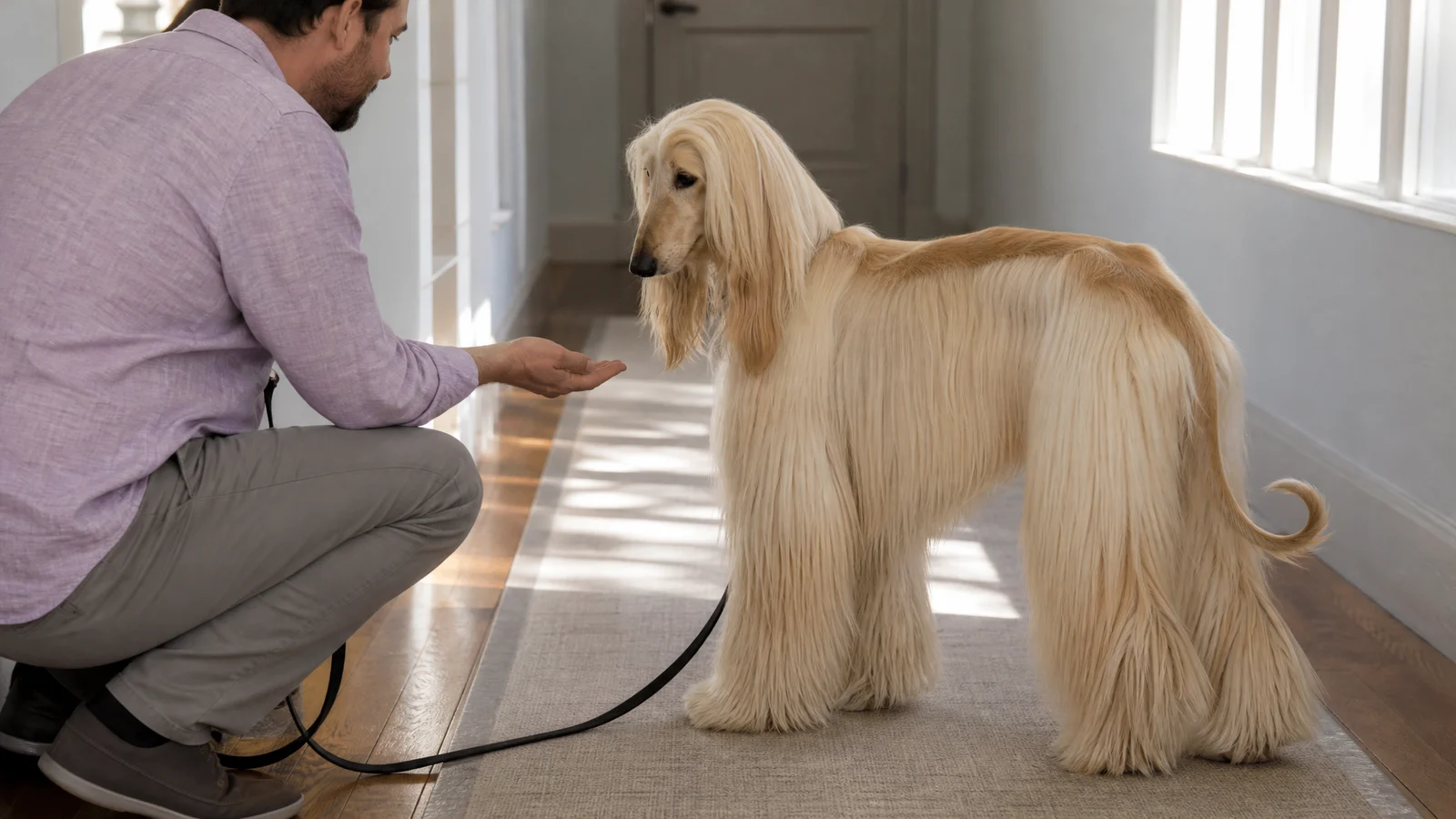
A voice sharpens at the hallway door over a missed sit or muddy paws heading for the couch. The Afghan Hound turns their head away, goes completely still, or walks off down the hall. It looks like defiance, and the usual human reply is to get louder.
What is happening is a dog reacting to tone, not defying you. The breed is known for a sensitive nature. A hound who feels pressured stops trying things, while one who feels safe keeps offering behavior and gives back deep loyalty. Our work centers on Afghan Hound behavior and training. Quiet cue delivery is where we begin.
Below, you'll find the beliefs that most often derail training, including that a louder voice teaches faster, that a turned head means spite, and that treats spoil a hound. Each one is checked against the breed and answered with calm cues, hand signals, quick rewards, and a routine for resetting a bad session.
What an Afghan Hound Sensitive to Harsh Tones Hears
The first belief is that a dignified, distant breed must be thick-skinned. The American standard describes the temperament as aloof and dignified, and an Afghan who barely glances at a stranger can look like a dog nothing could rattle. That reading mistakes reserve for toughness.
Aloofness is a social style, a choice about who earns attention. It says little about how deeply tone registers once someone matters to the dog. The same standard lists sharpness or shyness as temperament faults, which shows how narrow the gap is between a poised hound and a worried one.
Here is one way to hold the idea. Tone works like a facial expression: the words may be identical, but a clipped, tight delivery announces trouble before the meaning arrives. Afghans are described as extremely loyal to the people they have bonded with, so your expression matters most to the dog who cares most about you.
The verdict is that the belief fails. Reserve toward strangers and sensitivity toward family sit side by side in this breed, and with family the same hound can turn exuberant and playful. Build every cue around that sensitive core.
Why a Dog Sensitive to Harsh Tones Gives You Less
The next belief says a louder voice teaches faster, because surely the dog will finally notice. Noticing is not the problem. The breed standard says Afghans do not respond well to harsh training and prefer to do things their own way, so extra volume tends to backfire.
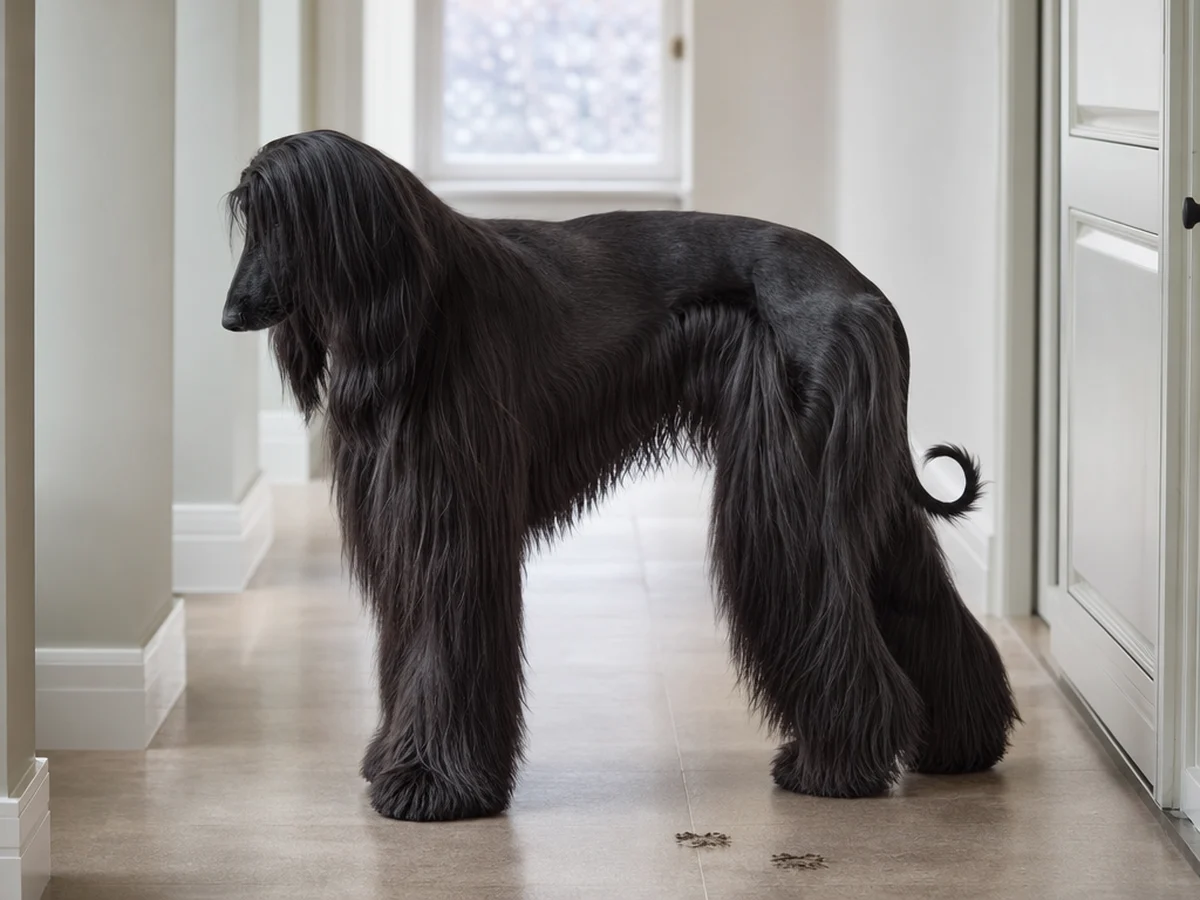
Take the mechanism one step at a time. A sharp tone pulls the dog's attention off the task and onto you, so they start scanning your face and posture for what comes next. A hound busy reading your mood is not working out which behavior earns a treat.
If the pressure continues, many dogs slide into shutdown, a state in which they stop offering behavior at all. That matters because learning runs on experiments. The dog has to try a sit, a down, or a head turn and discover what pays. A breed rated 1 of 5 for trainability, labeled self-willed, has little spare cooperation to lose.
You will hear advice to sound firm and confident. For this breed, firm should mean steady, not loud. Say the cue once, low and flat, then wait quietly while the dog thinks, because repeating the word at higher volume turns a question into a demand. If the dog is far away, walk closer instead of getting louder.
Do Afghan Hounds Ignore Cues Out of Spite?
Another belief says a turned head or a missed cue is willful, a hound deciding to snub you. Spite requires a dog to plan a reaction meant to hurt someone, and nothing in this breed's profile points that way. A fairer test is to describe what the dog is actually doing.
Sometimes the Afghan is simply thinking, since this is a strong-willed, independent breed and a pause before acting is part of how they work. Sometimes the sighthound in them is scanning. The breed has a very well-developed chase instinct, so movement across the street can pull attention away with no ill will.
Other times the cue means nothing yet in this room, because a dog who sits in the kitchen has not automatically learned to sit by the front door. And sometimes the dog has shut down after a tense tone. The last two can look alike but need different fixes, since confusion calls for a clearer cue and stress calls for a softer session.
To tell them apart, look for stress signals in the body. The list below shows what matters:
- Lip licking, pursed lips, or repeated yawning that has nothing to do with being tired.
- A lowered head and eyes that slide away from your face.
- A body that turns sideways or drifts to the edge of the room.
- Stillness that continues even when a treat appears.
When you see these, go back to an earlier, easier step instead of repeating the cue. The verdict is that spite is not what is happening. The dog is thinking, scanning, confused, or stressed, and each has a gentle answer.
Hand Signals for an Afghan Hound Sensitive to Harsh Tones
Many people treat the spoken word as the real cue and the hand signal as decoration for noisy days. For a hound sensitive to harsh tones, flip that ranking. A signal carries no tone, so it cannot sound angry, and it speaks to a sighthound whose eyes are tuned to movement.
A cue is any signal that tells the dog which behavior will pay. Teach the hand signal first and let your voice join later as the quiet partner. Keep your arm movements smooth, since a stabbing finger or a sweeping swing can feel as loud to a sensitive hound as a barked word.
Sit With a Lifted Palm
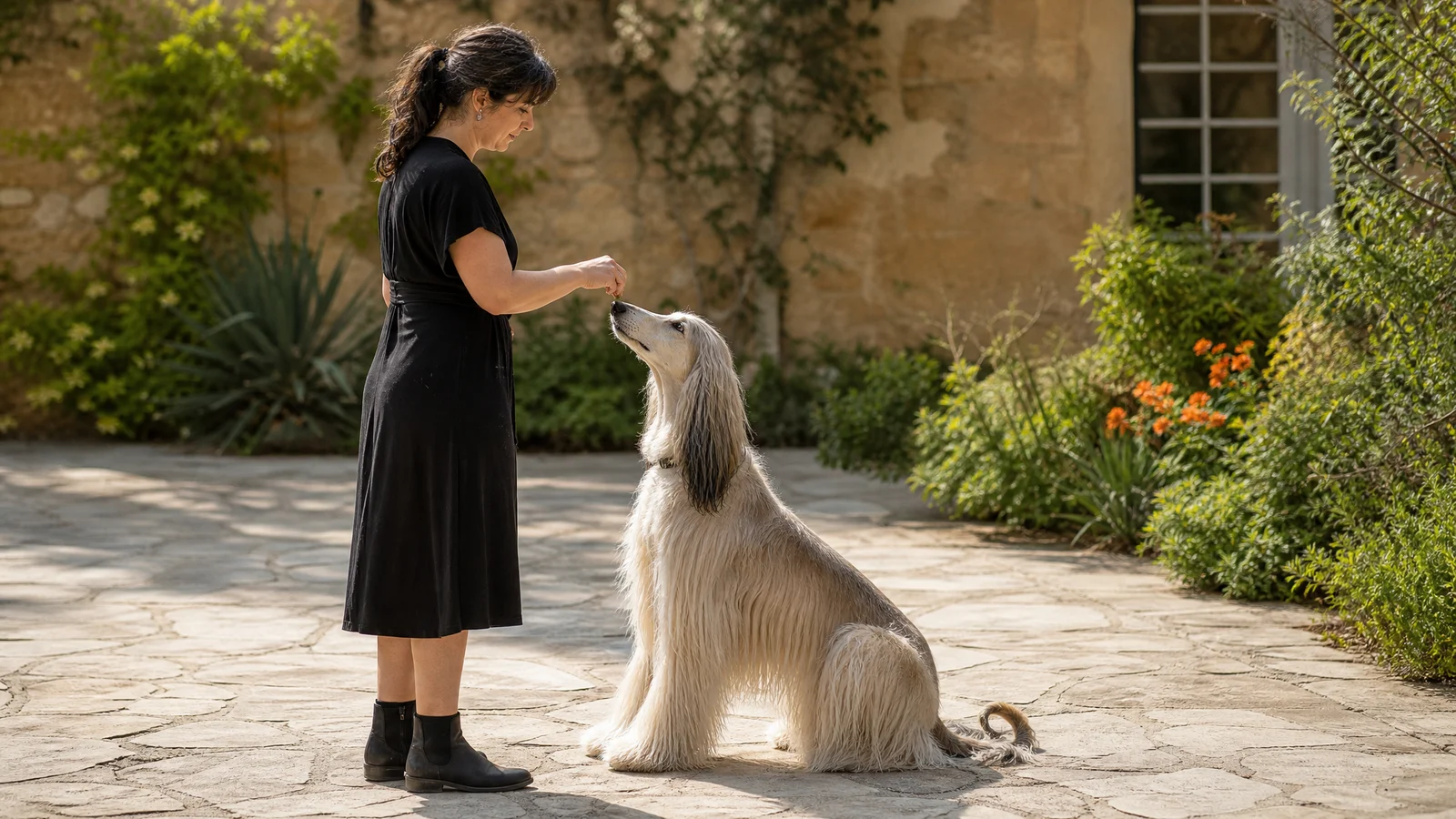
Hold a treat in your open palm at hip height and raise your hand slowly toward your chest. The dog's nose follows, the hips lower, and when they touch the floor you say your marker word, yes, and give the treat. A marker word is a short, steady sound that tells the dog the behavior just paid. Repeat until the lifted palm alone draws the sit, then keep the treat in your other hand.
Down With a Lowered Palm
From a sit, hold a treat between your fingers and lower a flat palm slowly toward the floor in front of the dog's paws. When the elbows touch down, mark and reward. If the dog hesitates, shrink the movement and reward a partial lowering, then build up gradually. Let the dog lower themselves rather than guiding them with your hands.
Come With a Soft Scoop
Stand with an arm out to the side and sweep your hand slowly toward your stomach as the dog moves in, then mark and reward beside your leg. Teach this indoors, on a leash, or inside a high, secure fence. Afghans have a strong instinct to run off after perceived prey, so walking one off leash is not advisable no matter how well they know the signal.
Fading the Spoken Word
Once the dog follows the signal smoothly, say the word in a low, even voice and give the signal a beat later. After many repetitions the word starts to predict the signal, and eventually the dog may answer to the word alone. Keep the signal in your toolkit anyway, because it carries the cue on days when your voice is tired or tense.
If a session starts to wobble, drop the word entirely and ask in silence with the signal. A quiet, wordless cue is often the fastest way to lower the temperature for both of you.
Quick Rewards for an Afghan Hound Sensitive to Harsh Tones
The worry is that frequent treats make a dog dependent, lazy, or slower to respond. With this breed the opposite is more often true, because an independent Afghan quietly asks what is in it for them and answers according to the pay. Treats do not spoil dogs. Slow, vague, or late payment does.
Quick means the treat arrives right after the right behavior, and small means the dog finishes it and is ready for the next request. The marker word closes the gap: say yes in your calm voice as the hips touch the floor, then deliver the treat. Because the word lands during the right behavior, the dog learns which part earned the payment.
Once a behavior is reliable, thin the schedule gradually by rewarding most repetitions, then some. Vary the payment among tiny treats, soft praise, a short game, or a fast lap around the secure yard, and pay best for the hardest tasks.
Finish every session on a win. Close with a cue the dog knows well, mark it, reward it, and stop while they are still bright. A sensitive hound remembers how a session felt, and a pleasant last moment shapes how willingly they come back tomorrow.
Everyone's Voice at Home Shapes a Sensitive Dog
Another belief holds that only the trainer's tone matters and the rest of the household can speak however they like. A bonded Afghan listens to every person in their circle. A hound who hears calm cues from one person and sharp words from another learns that the house is unpredictable, and unpredictability is stressful for a dog this sensitive. Agree on a few simple rules together:
- Each cue gets one spoken word and one signal, used by everyone, so the dog never has to decode a new version.
- When the dog does something unwanted, the response is a calm redirect to a known cue plus a reward, not a raised voice.
- Visitors ignore the dog at first and let the aloof Afghan approach in their own time, with no loud greetings and no reaching over the head.
- Children use the signals and a quiet voice, and an adult stays close for every interaction.
- Anyone who feels frustrated hands the session to someone else or stops for the day.
Children deserve special attention. Squealing, running, and sudden grabs are loud in ways kids rarely notice, and a hound who stiffens or leaves the room is asking for distance. Teach children to offer a treat on a flat hand and to let the dog choose whether to come close.
The goal is predictability, not strictness. A household whose voices stay in a steady range lets the dog relax, and a relaxed hound learns faster than a watchful one.
One Harsh Tone Does Not Ruin an Afghan Hound's Trust
The fear is that a single angry moment causes lasting damage. Trust with a dog is built from patterns, and a rare slip surrounded by calm, fair days does not erase them. What wears trust down is harshness that repeats and is never followed by repair, so the skill to learn is the repair itself.
Treat your own frustration as a signal to stop, not a reason to try harder. Put the treats away, drop your shoulders, and lower your voice. Then follow this routine:
- Pause. Look away from the dog and let them leave if they want to.
- Soften. Breathe slowly until your voice is back to a low, even pitch.
- When the dog looks relaxed, ask for one very easy cue they know well, using the hand signal and a quiet voice.
- Mark and reward that success generously.
- End the session there and return later in the day or the next day.
Make the next few sessions easier than the last. Ask for less, reward more often, and finish earlier than you planned. A sensitive Afghan forgives a sharp moment readily when you answer it with calm.
Book regular vet visits, and tell your vet if your dog suddenly pulls away or changes how they move. A hound who avoids contact may be uncomfortable rather than upset with you.
Calm Cue Delivery Keeps an Afghan Hound Engaged
Every belief above rests on the same assumption, that volume equals clarity. For this breed the reverse holds. A calm, even tone is a trainable skill, like a clean sit, and it takes practice rather than a gentle personality. A quiet voice, a clear signal, and a quick reward tell a loyal, independent, sensitive hound what you want, and they keep choosing to give it.
Most owners move on to a few related questions. If an Afghan keeps ignoring a cue even in a calm session, choosing rewards an independent dog values explains how to make the payment worth their while. If your dog already seems fearful or withdrawn, Afghan Hound sensitivity to harsh tones goes deeper on rebuilding confidence.
Owners of young hounds often ask how to keep natural reserve from turning into shyness, and socializing an Afghan Hound without shyness lays out that plan. To see where gentle cues fit from the first weeks to a settled adult, read the training roadmap for Afghan Hounds. Whichever you open first, the habit stays the same: speak evenly, signal clearly, reward the right moment, and stop on a success so your Afghan walks away from every session feeling they got it right.
 Puppy trainingKeeping Training Steady as Your Afghan Hound's Coat Changes
 Puppy trainingHow to Stop Afghan Hound Puppy Biting
 Training basicsHow to Teach an Afghan Hound to Sit