 Afghan Hound
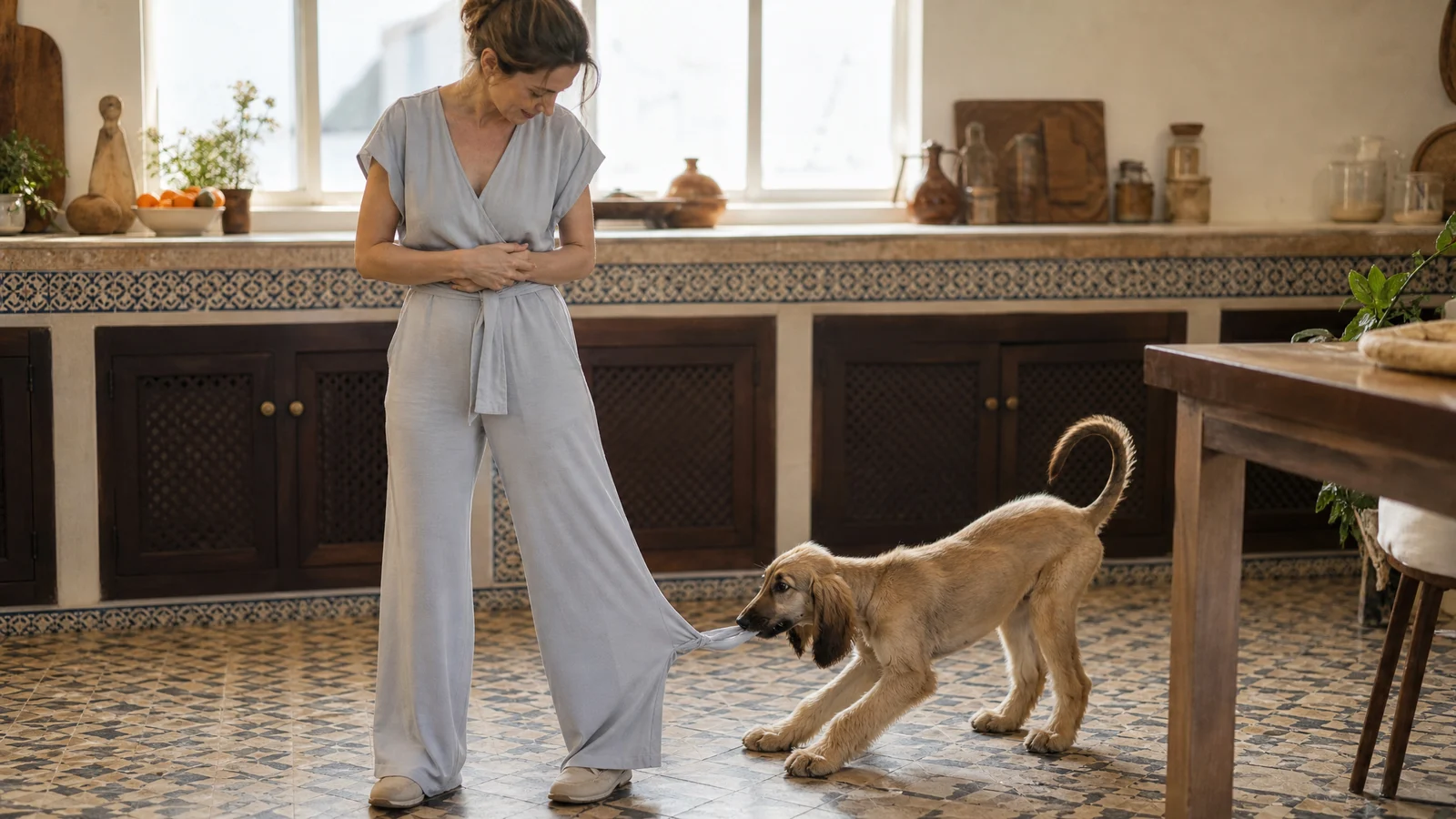
Sleeves, trouser legs and the hands that were supposed to be petting all make easy targets for a puppy's mouth. Puppies use their mouths in play, and a household can change what happens next in the few seconds around a grab without holding a muzzle shut or raising a voice.
The breed adds one detail. The American Kennel Club Afghan Hound profile calls Afghans independent, dignified and aloof in general, but affectionate and extremely loyal to humans they have bonded with. Most of this page lives on that second side, the family at home and the games that get too exciting.
This page stays with the everyday version, grabs at home around hands, clothing and the grooming brush. Mouthing also has more than one cause, and the answer to a game that got out of hand is not the answer to a puppy trying to leave a touch.
Setting Up Afghan Hound Play to Head Off Puppy Biting
Most grabs have a build-up, and the build-up is where a household has the most say. The AKC puppy biting guidance notes that a biting puppy is sometimes an overtired puppy who needs a nap in a quiet space or crate. Other times the puppy needs a potty break, or is hungry or thirsty.
So the first question is not how to stop the mouth. It is whether this puppy needs rest, the yard or a meal. Ask it before a game starts and again when the mouthing turns frantic, because a puppy who has been up too long can look exactly like a puppy who wants to play harder.
Choosing the Game
When play is the right answer, arrange it so teeth have somewhere else to go. The ASPCA puppy mouthing guide recommends non-contact play such as fetch and tug-of-war in place of wrestling and rough play with the hands. That puts the game at the far end of a toy and keeps your fingers out of the target zone.
Choose a spot with room to move and nothing to pin your sleeves against, and start the game with the toy already in your hand rather than fetching it after the first grab. Short rounds that end while the puppy is still choosing the toy work better than long ones that end because someone got bitten.
When Visitors Are Involved
Grabbing that shows up mainly around visitors or unfamiliar dogs is a separate question with its own plan. Rather than stretch this page over it, we would point the household to the Afghan Hound socialization guide and come back here for the everyday version, the one with sleeves and hands.
The Seconds After Afghan Hound Puppy Biting Begins
The response is short and deliberately dull. Go still, tuck your hands against your body and, if it is safe to do so, step out of reach or put a gate between you and the puppy. The game has ended, and nothing about the ending needs to be dramatic.
Holding the muzzle shut, pushing the puppy off and wrestling them away all turn the moment into a bigger, more exciting contest. So does flapping your hands to ward them off. A calm exit that happens the same way every time teaches more than any single clever reaction, and it protects your skin without asking the puppy to fight for anything.
It helps to decide the exit route before play begins. Know where the gate is, avoid sitting where sleeves can be pinned against furniture, and ask children to walk away and fetch an adult instead of running. A running person is a very good thing to chase.
Coming Back to Play
Wait until the puppy can look around, sniff, take a drink or wander toward a suitable activity without diving at your hands. Then return calmly and start with something quieter than what you left. If the puppy launches again the instant you reappear, the pause was too short or the game too lively, so lengthen the rest or pick a calmer option.
A puppy who comes back loose and curious is ready for the toy. A puppy who comes back stiff and fast may need a nap, a potty trip or water first, which is the same checklist from the start of this page.
Hands, Sleeves and Coat as Puppy Biting Targets
The same teeth turn up in quite different situations. A puppy who is chasing a moving sleeve is playing, and a puppy who clamps down during brushing may be trying to end the touch. Each needs its own small adjustment, so it pays to notice which one you are looking at.
Fingers, Toys and Tug
Hands are the easiest target because they are always close and always moving. Keep a toy in reach and play with it, not with your fingers. When the puppy takes the toy and keeps their mouth off your skin, the game goes on, and that is the payoff that makes the toy the better choice.
Tug can be part of this when it has a clear shape. The puppy takes the toy, you keep your hands at the far end of it, and the game stops the moment teeth touch skin. Starting and stopping the same way each time lets the puppy learn where the line is without a lecture, and the stop is never a punishment, just the end of the fun for that round.
Swinging Fabric
Clothing is tempting because it swings, so the cheapest fix comes before any grab. On the days you are working on this, wear clothes with less to catch: snug cuffs instead of loose ones, no trailing hems or ties. It is an easy household change, and it removes the best targets before the puppy can practice on them.
If fabric is already in the puppy's mouth, the order is stillness first. Pulling away turns the cloth into a tug toy, and holding still gives the puppy nothing to chase. Once the grip loosens, the toy comes out and the game moves to it.
Children and a Mouthy Puppy
Children move fast and squeal, which is exactly what a puppy in a grabbing mood finds most interesting. An adult should supervise any play between them, and children can learn the same dull exit as everyone else: stand still, fold their hands in and then walk away calmly. If a child gets nipped, the adult steps in, ends the game and lets everyone settle before anyone tries again.
It also helps to give children their own part of the game that does not involve hands, such as tossing a toy for the puppy to carry back while an adult stays close. Whatever the children do, the adult stays close enough to step in.
The Coat and Handling
Brushing, paw checks and ear checks are a different category, because the touch itself may be unwelcome. A puppy who mouths at the brush or hand is not necessarily playing. Stop the handling, give them room to leave and return later to a smaller step. The Afghan Hound handling practice guide builds that gradually. These signs mean the contact is not play, so pause the task instead of trying the same touch again:
- Freezing or going rigid when touched
- Turning away or repeatedly trying to leave
- Hiding or going to a quiet corner
- Tense resistance to being handled
Keep regular veterinary visits part of ordinary puppy care, and see a veterinarian if mouthing starts suddenly or if you think the puppy may be uncomfortable or in pain. Contact a qualified reward-based professional when a bite breaks skin, when you cannot interrupt it safely, or when it keeps appearing around fear, guarding or unwanted handling, which are outside what this page covers.
Switching the Game or Ending It When a Puppy Mouths
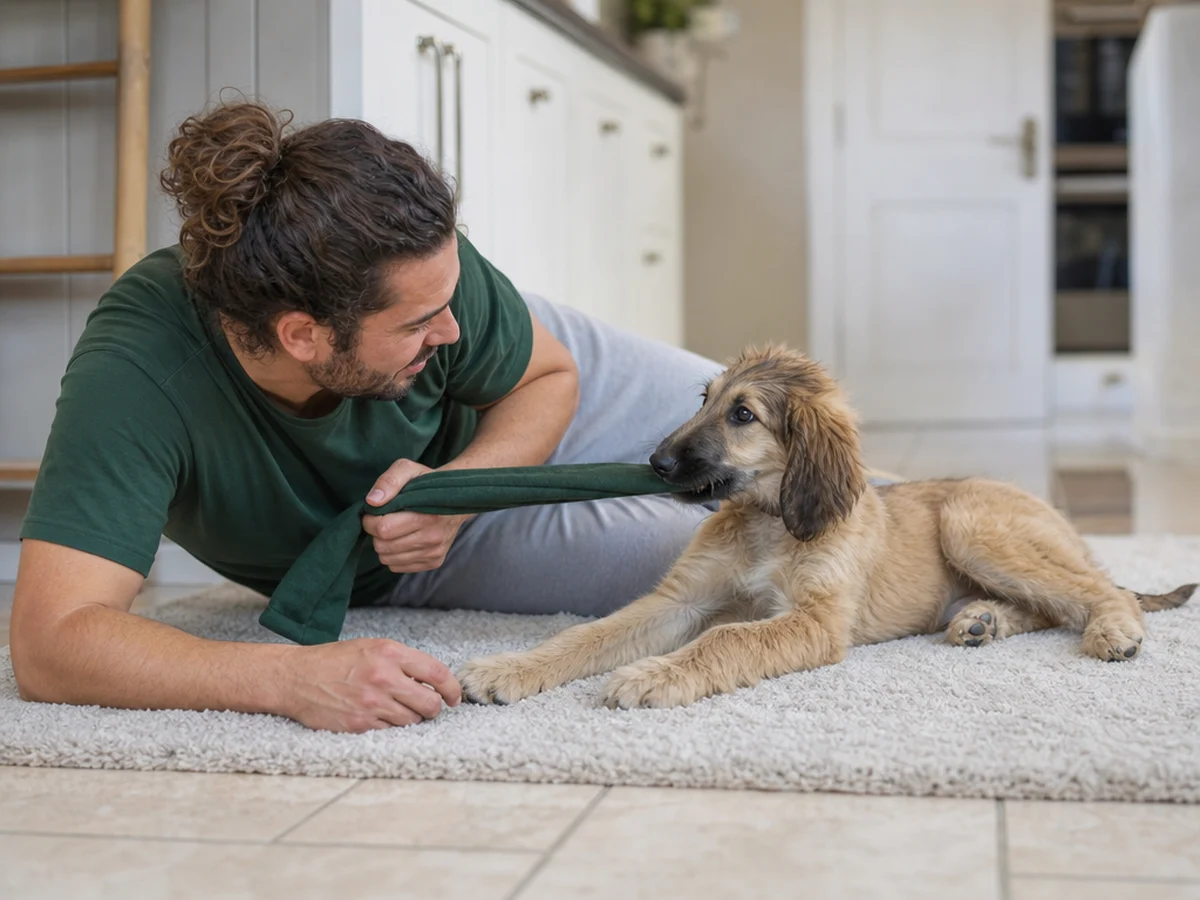
Not every grab calls for the same exit. Two quick questions sort most of them. Can the puppy still notice the toy, and does the puppy let go when you go still? If both answers are yes, offer the toy and carry on. If either answer is no, the better move is to end the game and let the puppy settle.
Offering a toy to a puppy who is already racing at your legs usually adds fuel. The offer gets ignored, the grab continues and the person ends up repeating the same move louder. Treat that as a sign the puppy is past the point where a switch can work. End the game, give space and try again after a rest.
Before a game starts, agree on one rule for tug: the puppy takes the toy, hands stay at the far end, and teeth on skin ends the round every time. A rule that never changes is easier for a young puppy to read than one that depends on the mood of the day.
Switching works best early, while the puppy is still approaching with a loose body. Ending works best when the pace has already risen. Learning to tell the two apart is most of the skill, and it improves with a few days of watching how a particular puppy builds up.
Paying for the Gentle Mouth
Reward the moments you want more of. Good ones include turning toward the toy, putting all four paws on the floor, letting go of clothing and pausing when you go still. The reward can be a small treat from the puppy's normal food, or simply the game carrying on.
Redirecting is better than punishing. The PDSA chewing guidance says not to punish a dog for chewing, because punishment can make them scared of you and they will probably learn to do it when you are not there. It advises redirecting to a safe toy and praising. The same thinking applies to a puppy who has just grabbed a sleeve.
Timing matters more than size, and the same goes for a game that ends: stop it at once, then reward the next calm moment. Deliver the reward while the gentle behavior is still happening, not after the puppy has already moved on to the next grab. A puppy who is rewarded for letting go of a sleeve a second late may be paid for the grab that came right after it.
Chewing on household objects like shoes or furniture is a related but separate job. Remove access, offer something suitable and praise the switch. It should not turn into a chase, because a chase is play too.
One Rule for Everyone
Best Friends Animal Society says that anyone who interacts with the dog should know how to discourage mouthing, and warns against mixed signals, meaning mouthing allowed with some people but not others. In practice a puppy should learn that teeth on skin end the game with everyone, even when the games themselves differ.
| The moment | What tends to backfire | What to do instead |
|---|---|---|
| Teeth land on a hand | Waving the hand or pulling it away | Go still, tuck the hand in and end the game |
| A sleeve is in the puppy's mouth | Tugging back or running | Stop moving, wait for the grip to loosen, then offer the toy |
| The puppy returns after a pause | Restarting with fast, hands-on play | Begin with a calmer toy game and reward the gentle start |
| The puppy mouths during brushing | Pushing through the task | Stop, give room to leave and try a smaller step later |
A Quieter Mouth Without a Deadline
Nothing we draw on puts a date on when an Afghan Hound puppy leaves mouthing behind, so we leave the calendar out. What a household can aim for is a clearer sequence: the game ends sooner, the toy is already in hand, and the return to play is calm.
No plan removes a puppy's urge to mouth entirely. What the plan changes is where the mouth is allowed to go. Suitable items stay available, skin and clothing stop being part of the game, and a puppy who is uncomfortable or in pain gets a veterinary check instead of more training.
Progress shows up in small, repeatable moments. The puppy reaches for a sleeve, the person goes still, the toy appears, and the sleeve is left alone.
 Training basicsHow to Teach an Afghan Hound to Sit
 BehaviorHow to Teach an Afghan Hound to Jump Over Obstacles
 Exercise and jobsHow to Teach an Afghan Hound to Shake and High Five