 Afghan Hound
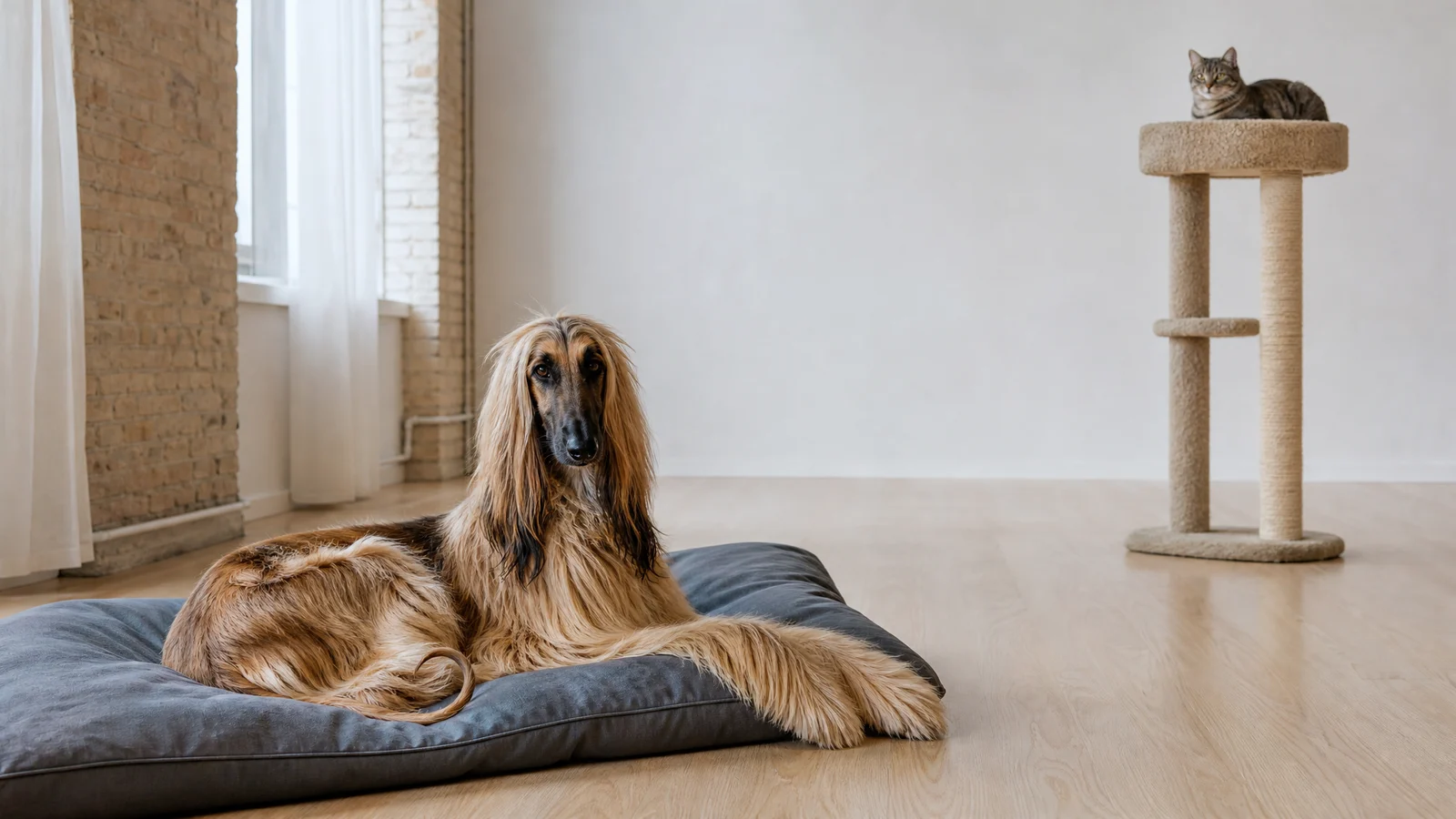
The most useful question to ask about an Afghan Hound and another animal is not whether they will get along. It is whether every animal in the house can eat, rest and cross a room without having to deal with the other. When the answer is yes, a relationship has room to form. When it is no, good intentions on the dog's side will not fix it.
No breed description can promise either outcome, so each pairing gets read on its own evidence. This page looks at what changes when the other animal is a cat, a second dog or a small pet.
One thing applies to every pairing. An adult watches every interaction, and separation stays available the whole time. For some households separation turns out to be the arrangement, and that is a sound result.
Afghan Hound Chase Instinct and Other Pets at Home
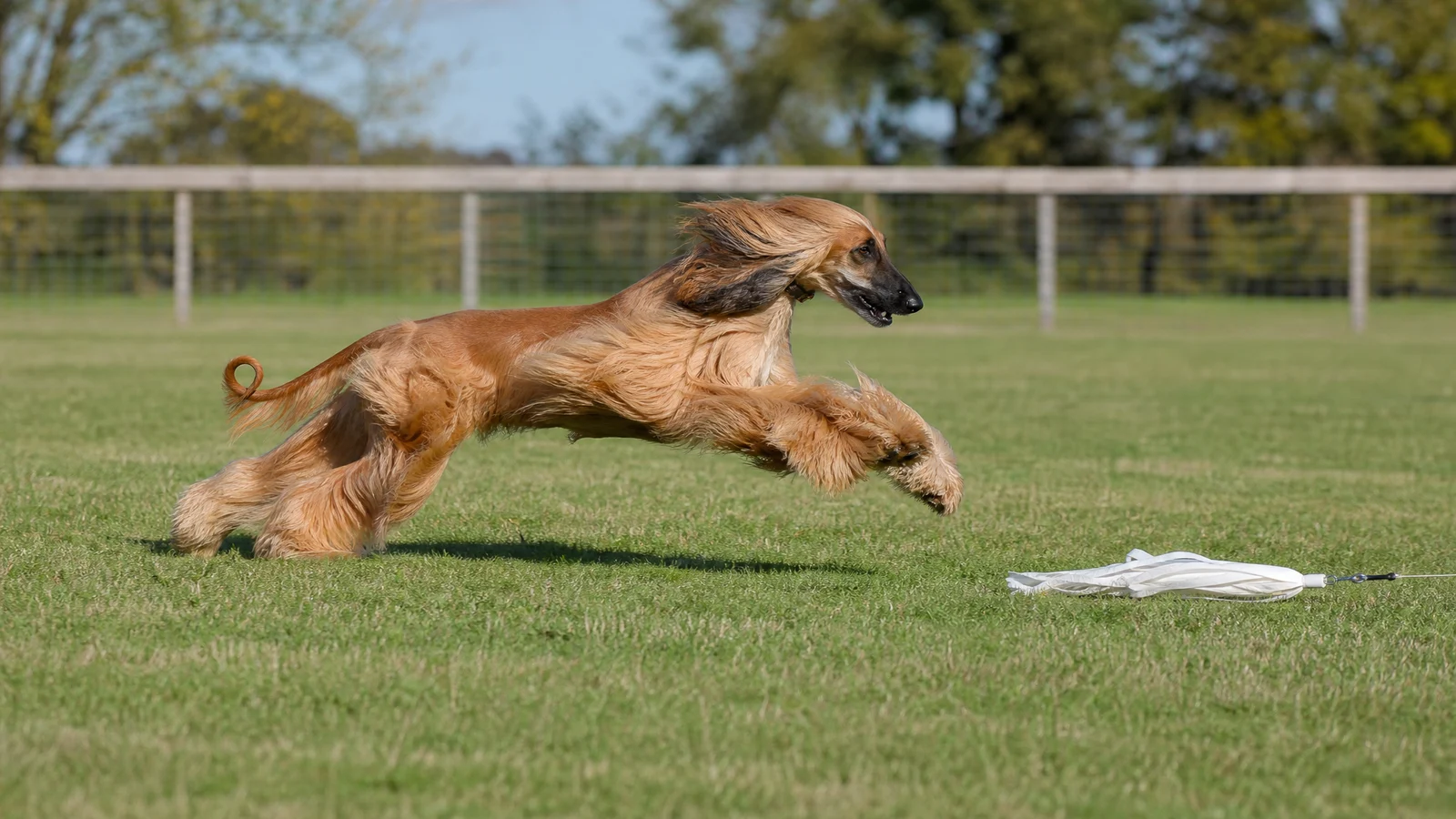
The AKC Afghan Hound page describes a strong instinct to run off in pursuit of perceived prey and says that walking off leash is not advisable. The word to hold onto is perceived. Our caution from that word is that a cat crossing a hallway, a small dog bolting after a toy or a caged pet scrambling are the kind of movement we would treat as a possible trigger, whether or not the animals have lived calmly together before.
That description is about the breed and tells us nothing about the individual dog on your sofa, so it rules out a promise in both directions. We cannot say an Afghan will be safe with cats, and no one can say one will not be. What follows from it is a plan built for the dog who turns out to have a strong chase response, since we cannot know in advance which dog that is.
Why Chase Tests Add Nothing
For the same reason, skip any test that depends on the smaller animal running. Letting a cat dart past to see what the dog does, or loosening the leash to find out, produces a chase opportunity and not evidence. Calm observation through a gate, with the dog on a leash and an adult holding it, gives the household a clearer picture than a staged chase, and it does not ask the cat to take part in a test.
The household also learns something about its own routines this way: whether the leash handler can stay focused, whether the gate latches and whether the cat can leave the room without the dog following.
Introducing an Afghan Hound to a Resident Cat
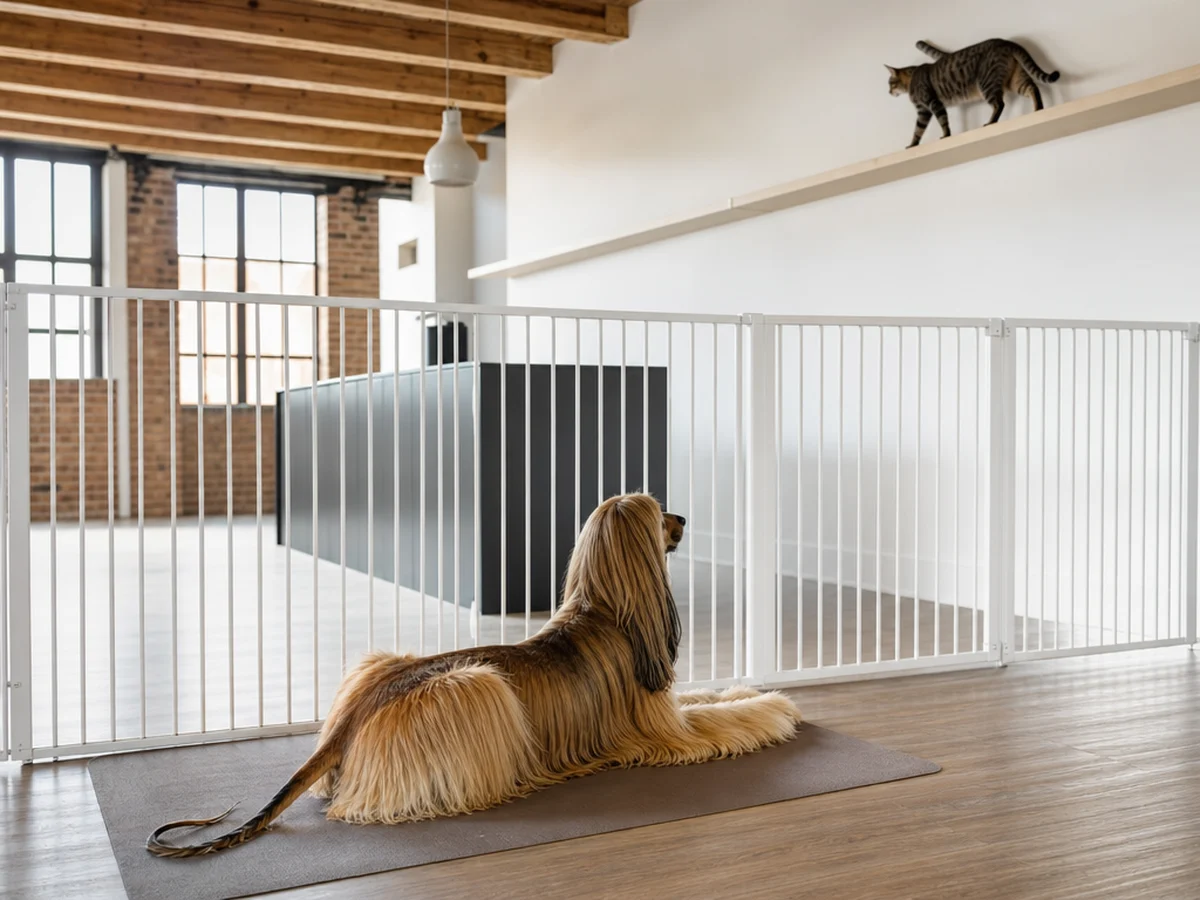
A cat meets a dog with a different set of tools. Cats can climb, hide and leave, and the whole arrangement works only while those options stay real. Before any shared time, check that the cat can reach food, water, a litter box and a place to rest without walking past the dog or through a doorway the dog controls. If the route to the litter box crosses the dog's area, the cat has lost something it needs, whatever else is going well.
The AVMA socialization guidance recommends rewarding positive or neutral engagement with praise, play and treats, allowing a pet who seems uncomfortable to withdraw and moving at a pace that suits that pet's personality. For an Afghan, that means paying the dog for calm looks and easy movement, and treating the cat's leaving as a normal part of the session and not something to prevent.
Because the cat has a vote, the cat's behavior is as useful as the dog's. A cat who eats, passes through the room and settles where it can see the dog is telling you something different from a cat who hides, stops eating or only appears when the dog is out of sight. Neither is a verdict. Both say how large the next step can be, and sometimes the answer is to end the session and try again later at a greater distance.
Where the Detailed Method Lives
The setup, the step-by-step progression and the signs a dog should not be alone with a cat are laid out in our Afghan Hound cat introductions guide. Use it for the method.
The adult who watches a cat and an Afghan together has a job with a clear end point: if the cat leaves, the session is over, and if the dog fixes on the cat, the session is over too.
Afghan Hound Introductions With a Resident Dog
Two dogs add a different problem. Either dog can chase, and either can be chased, so excitement can build on both ends of a leash. The first meetings usually go better with a second handler, distance and room to turn away. The broader groundwork for greetings sits in our Afghan Hound socialization guide, and this section covers what changes once the other dog lives in the same house.
Plan the early meetings with two adults, one for each dog, and give each handler an easy way to walk their dog away. Parallel walking at a distance, and then a calm approach when both dogs look relaxed, gives the pair a chance to notice each other without the pressure of a face-to-face greeting. End the session while both dogs are still doing well and do not stretch it to see how long that lasts.
Which dog arrived first matters less than whether each has its own territory to return to. A resident dog needs the house to still feel like theirs. A newly arrived Afghan needs a place that is theirs from the first day, with an area they can leave and return to without crossing the other dog.
Play needs careful watching too. Our rule of thumb, from the principle that an animal should be able to withdraw when uncomfortable, is that play is going well only while both dogs can pause, turn away or leave. Stop the game when one dog stops choosing to join in.
Where Each Dog Eats, Sleeps and Keeps Chews
Before the dogs share a room, decide where each one eats, sleeps and keeps favorite items, and make those places hard for the other dog to reach. Best Friends guidance says that putting a hand in a dog's dish while they eat, or often taking food away, can create resource guarding. So do not test how the dogs behave near a bowl by approaching it, and do not send one dog toward the other's food to see what happens.
The same logic covers chews, toys and the spot on the sofa. Feed in separate rooms, pick up toys before the dogs share space and let each dog finish and walk away on their own.
When Two Dogs Cannot Relax Together
Some pairs do not relax even when the setup is right. If two dogs keep fixating on each other, rushing at a gate or cannot rest in the same room, back to separate areas and get help. The ASPCA aggression page says the safest and most effective way to treat an aggression problem is behavior modification guided by a qualified professional, and that it works by rewarding good behavior.
Play that turns into pressure is a second reason to separate the dogs. We would treat one dog cornering or hounding the other, a dog who stops playing but cannot get away, and play that escalates instead of pausing as signs to end the session. Interrupt calmly by calling each dog to a different spot and rewarding them for coming, then let both settle apart before deciding whether to try again.
Chasing games deserve extra caution with a dog who has a strong chase instinct, so when toys do come back out, ones that each dog can carry are a better fit than racing. We would also keep play sessions short, since the aim is to pay for calm, easy moments and not to see how far the game can go.
Until professional help is in place, nothing needs to be solved by putting the dogs together. Rotating them through the house on separate schedules is a normal holding pattern.
Afghan Hounds, Small Pets and Crowded Households
A rabbit, a bird or a rodent adds a third kind of case. These animals are small and may move quickly or erratically. The breed description quoted earlier says nothing about small pets, so linking the two is our own caution and not the AKC's. The practical answer is a physical one: housing that the dog cannot reach, knock over or open, in a room that can be closed when no adult is watching. A dog who has done well with a cat has not shown anything about a hamster.
The animal's own veterinarian is the right person to ask about housing, handling and stress for the smaller species. Our part is the dog's side, which is that a closed door is cheaper and safer than any amount of hoping.
If a smaller pet lives in the home, the dog's reward-based practice still helps. Pay the Afghan for settling in another room, for walking past a closed door without stopping and for choosing a chew over the doorway. None of this changes the closed door, which remains the real protection.
More Than Two Animals
Households with three or more animals face a quieter issue. Every animal adds a pair, and each pair is its own relationship. An Afghan who has settled with the first cat may meet a second cat as a stranger, and a resident dog who is easygoing with the Afghan may feel crowded when a puppy arrives. Introduce one pair at a time, and give a newcomer the same separate resources and retreat the first animals got, whatever the existing animals seem to tolerate.
Afghan Hound Cohabitation Across Months and Years
Living together is mostly a long series of ordinary minutes, and those are the minutes when supervision slips. A dog and a cat who have spent weeks lying in the same room can still end up in a hallway at the wrong moment, and the plan should assume that moment will come. Doors, gates and routes that were set up for the introduction are best treated as permanent, because a household that dismantles them after a calm month has no plan for the day something changes.
Supervision does not retire when the animals seem settled. What changes over time is how relaxed the adult can be while still paying attention, not whether an adult is there. A person who is cooking, on a call or half asleep is not supervising, and in those moments a gate or a closed door does the job instead.
That is why we suggest reviewing the arrangement on a schedule and not only after a problem. A short check each few weeks is enough: does every animal still reach food, water, rest and the bathroom without passing another? Are the gates being used? Does anyone avoid a room?
Changes That Reopen the Question
Some events make a settled arrangement a new one, and it helps to name them in advance so the household treats them as restarts instead of exceptions. These are the ones to watch:
- A new animal joins the household, which adds a pair and changes the existing ones.
- The household moves or renovates, which changes the doors, hallways and retreats the animals had learned.
- An animal's energy, appetite or willingness to be near the others changes, which calls for a vet visit before anyone assumes the relationship is the cause.
- Visitors arrive with their own animals or leave doors open that are normally shut.
We recommend regular vet visits for every animal in the home, since health changes can alter how an animal behaves around the others. When something does change, pause shared time and have the animal examined. A veterinarian looks at health and a qualified behavior professional looks at the pair, and neither is replaced by a guess made at home.
Afghan Hound Households That Work With Other Pets
A working household can look many ways. Some Afghans and cats come to share a couch. Others ignore each other politely for years, and some pairs are best kept in separate parts of the house with a rotation that gives everyone the run of the home. All of these can be good outcomes if the animals are comfortable and the people can sustain the setup.
What none of them offers is a guarantee. Even the easiest pairing still gets an adult watching when the animals are together, and even a long-settled one keeps its gates and retreats in place. The measure of success is the daily life of each animal, including the one who is easiest to overlook.
 Training basicsHow to Teach an Afghan Hound to Leave It
 BehaviorCan an Afghan Hound and a Cat Really Be Friends?
 Exercise and jobsSafe Lure Coursing and Sports Jobs for an Afghan Hound