 Afghan Hound
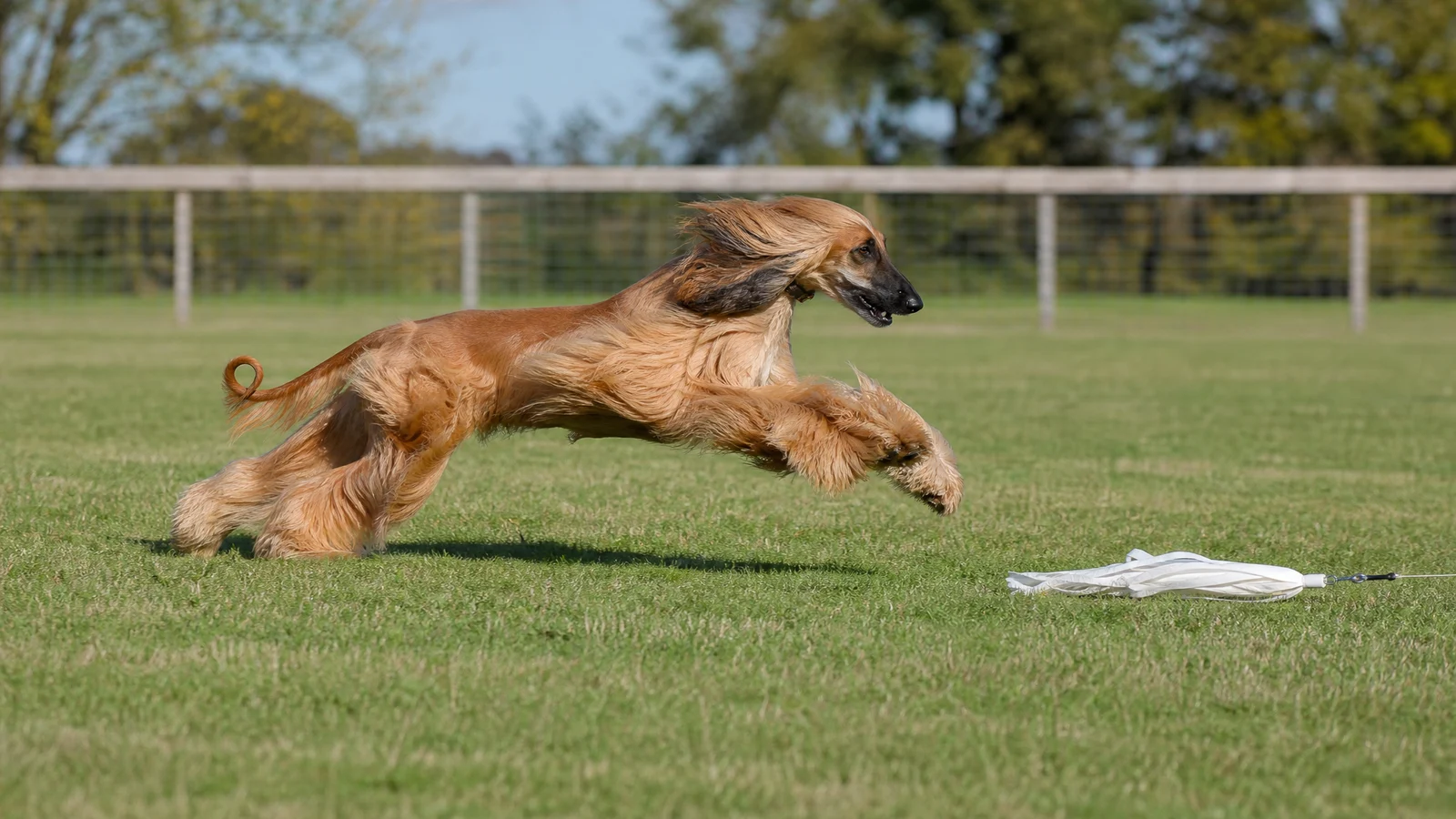
One Afghan Hound gallops full out in a fenced field several times a week, then folds onto the couch at home like a dignified houseguest. Another gets only leashed walks and turns restless, noisy and destructive by midweek. The gap between them is rarely training skill. It is whether the chase instinct has a safe place to go, because a sighthound without one will invent an outlet in your living room or past your fence line.
Organized sports are the most dependable answer. They supply enclosed ground, a lure worth chasing and people who understand hounds. Our years with this breed point the same way every time. In this article, we'll go through lure coursing, FastCAT and Rally, the fencing and venue checks that make any run safe, and how coat, joints and age set your limits.
Full-Speed Running Is the Baseline for Afghan Hound Dog Sports
Every sport here gets measured against one benchmark: how much true running your Afghan Hound gets out of it. The AKC says short walks do not provide enough exercise for this athletic breed, and that an Afghan should ideally run full out several times a week in a large, enclosed area. Anything that falls short of that has to be paired with something that doesn't.
The benchmark matches how the breed is built. Running free, an Afghan moves at a gallop, and their natural gait is described as the double suspension gallop. A sport earns its place by giving your dog that stride, safely and often, not by offering a pleasant outing.
Skip the common advice that one long daily walk covers a hound. On a loose leash an Afghan can trot at a fast pace, but a trot is not the gait this breed was shaped around. Long leashed runs can join the routine once your dog is mature, and they help, yet a leashed run is still not a gallop.
Hold every sport up against these checks before you sign up:
- Your dog gets to gallop, not trot, for a real stretch of the session.
- The ground is enclosed and the fence is high and secure, because Afghans are tall, lean, strong and excellent jumpers.
- You can repeat the running often, since several times a week is the target and a trial a few times a year is not.
- Your dog leaves tired and pleased, not frantic and not shut down.
Verdict: full-speed running, repeated through the week, is the standard every option below has to meet. For the routine between runs, read why short walks fall short.
Lure Coursing Fits the Afghan Hound's Chase Drive
Lure coursing is the closest match to what this breed wants to do. A lure moves across open ground, your dog pursues it at a gallop, and the whole thing happens in a controlled, enclosed setting instead of at the edge of a road. The breed has a very well-developed chase instinct, and this is the one sport that asks for that instinct directly and pays it back with a full-speed run.
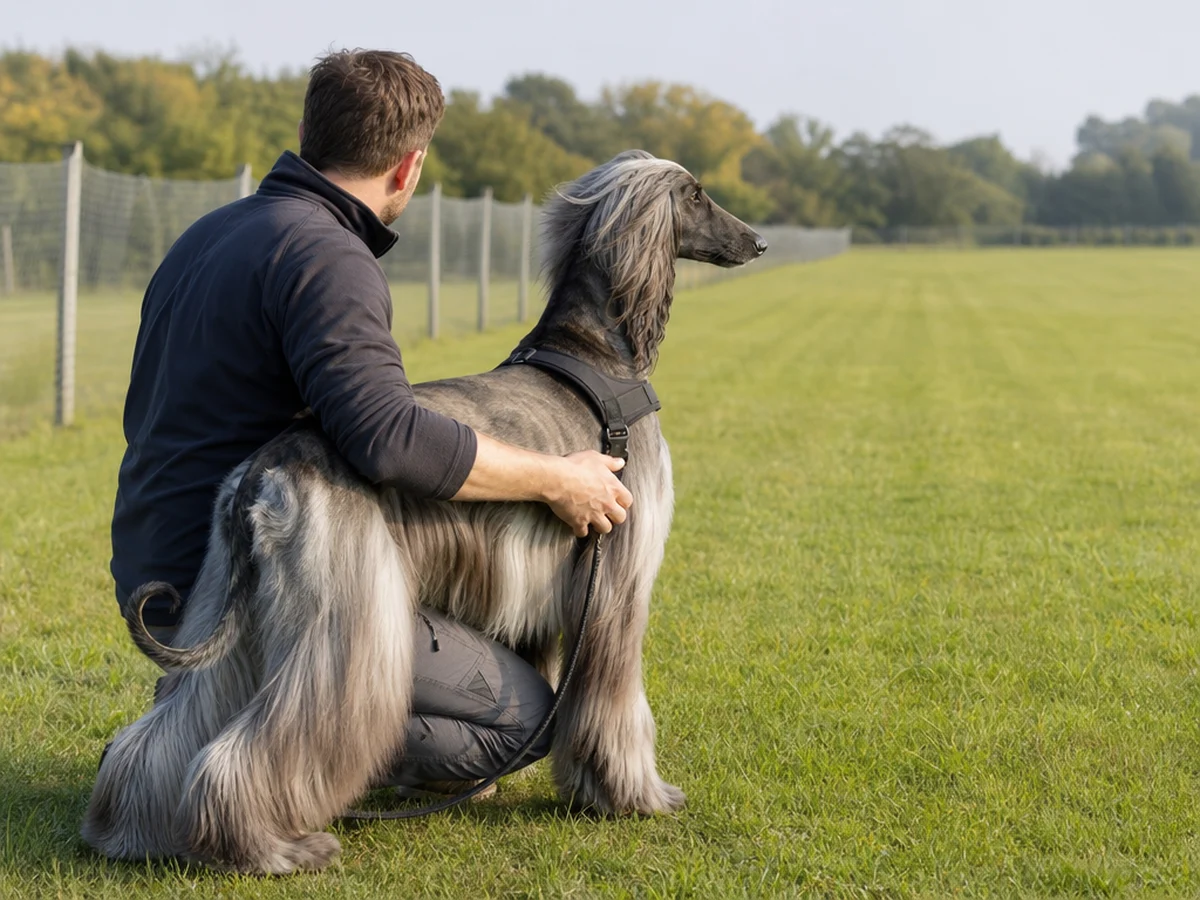
You will not be the first Afghan owner on the field. Club member profiles show Afghans in lure coursing, FastCAT, Rally and agility, often alongside conformation, and some breeders aim for dogs with the stamina to compete in several sports. Chasing a lure is part of ordinary life with this breed, not a fringe hobby. Their roots as a hunting hound explain the appetite, but the sport itself is only a run.
What Lure Coursing Asks of You and Your Dog
Your dog needs a sound body and a real interest in the lure. A first session is for learning the game, so give them time to look, sniff and work it out. You need to hold an excited hound calmly at the start. Dogs pull when they are excited or full of energy, or out of habit, so teach loose-leash walking at home long before you arrive, and reward every calm step.
Practice the waiting part too. Ask for a sit or a stand beside you, mark the moment your dog stays settled, and pay with a treat or a short tug game. A hound who can stay composed near excitement has a much easier day at the field.
Check the host club's rules on age, eligibility and registration before you enter. Do not assume a young puppy is allowed, and do not assume the coat needs trimming for the field.
Verdict: the best match for the chase drive. The one limit is frequency, because events come around only now and then, so lure coursing cannot be your only source of galloping. Pair it with a secure place to run between events.
FastCAT Gives an Afghan Hound a Straight Sprint
FastCAT is the low-commitment way in. Your dog runs a short, timed, straight sprint after a lure, so there are no turns to learn and no obstacles to clear. Club member profiles list FastCAT among the sports Afghans do, often next to lure coursing. A straight line also suits a dog who is aloof with strangers, because the whole job is finished before the crowd becomes a problem.
The limits are just as clear. A sprint is over fast, so a single run gives far less gallop than a session in a big enclosed field, and a trial day cannot stand in for your several-times-a-week running. Some hounds also get so wound up by the lure that the start line becomes the real work. Treat FastCAT as a sharp, brief outlet and a useful test of how your dog handles a lure, noise and strangers.
Finding events takes a few steps:
- Ask breed clubs and sighthound clubs near you which groups host lure coursing or FastCAT and when.
- Read the host club's event page or premium list for rules on age, registration and equipment.
- Go and watch first without your dog. Notice the noise, the crowd and how the start line is handled.
- Email the organizer with any question before you enter.
Verdict: an easy entry point and an honest reality check, but too brief to carry your dog's exercise alone.
Rally Suits an Afghan Hound Who Dislikes Drilling
Rally is the calm choice. You walk your dog past a line of numbered signs, each one calling for a skill, and you are allowed to talk to them and encourage them as you go. That relaxed, cooperative format suits a breed the UKC describes as a strong-willed, independent thinker, and one known for a sensitive nature. It avoids the endless repetition of formal drilling, which many hounds meet with a bored stare and a slow walk away.
Reward-based handling is the whole game. Carry small treats, mark the instant your dog gets a skill right, and end each practice while they are still interested. Teach each sign as a little game before you string them together. A cheerful handler gets further with this breed than a stern one, and a dog who enjoys the ring will check in with you without being nagged.
Where Rally Falls Short
Rally does not run your dog. The work happens at a walking pace, far from the gallop this breed needs, so a Rally-only hound will still be under-exercised and may start inventing games at home.
Use it for what it does well: it builds focus and a loose leash around distractions, and it gives a self-willed hound a reason to turn toward you. Club member profiles also show Afghans in agility, dancing and therapy work, so you can add those later if your dog enjoys them.
Verdict: the best teamwork builder and a poor workout. Pair it with real running.
Fencing and Field Safety Come Before Any Dog Sport
Safety decides whether any run is worth doing. Afghans are tall, lean and strong, which makes them excellent jumpers, so any place where they run needs a high, secure fence. They also have a strong instinct to run off in pursuit of perceived prey, and walking off leash is not advisable. Plan around secure containment and leashed outings instead of hoping for off-leash reliability.
Ignore the idea that a well-trained dog can earn open-park freedom. A recall that works in your kitchen does not survive a squirrel, and a sighthound at full speed covers ground faster than you can follow. Before you run your dog anywhere, check the following:
- Walk the full perimeter and look for gaps, dug-out spots and loose panels.
- Test every gate latch, and use a double-gate setup or a helper so your dog never has a clear line out.
- Look for anything near the fence, such as a bench or stacked crates, that gives a lean jumper a boost.
- Ask whether other animals, especially small ones, share the ground.
- Keep your dog on a leash in the parking area and on the way in and out of the venue.
The same instinct follows you home. If you share space with a cat, read about training calm around cats. If your dog seems to stop hearing you once something moves, the sighthound instinct behind these behaviors explains why.
Verdict: a high fence and a leash at the venue are non-negotiable, and no sport is worth a gap in either.
Coat, Joints, and Age Set the Dog Sport Limits
Your dog's body decides how much of each sport they can take, and the coat adds a chore on top. This section covers grooming after a run, then joints and age, then what each sport asks physically.
Coat Care After a Run
The breed standard asks for the Afghan Hound to be shown in a natural state, with the coat not clipped or trimmed, so you manage the length rather than cut it. Field and trial days add burrs, dirt and tangles. Check the coat, feet, pads and skin after every session, and build extra grooming time into your week.
Joints, Puppies and Seniors
The Afghan Hound is a medium-sized sighthound that combines speed with power and agility, but that build is made for straight galloping, not repeated hard jumping and tight turns. Keep puppies to short, easy play on soft ground and build up gradually. Save long leashed runs for a mature dog. Seniors can often keep running at a gentler level. Keep regular vet visits on your calendar, and ask your veterinarian when your dog is ready for each step.
This table shows what each sport asks of the body:
| Sport | Galloping | Physical demand |
|---|---|---|
| Lure coursing | Full gallop on open ground | High: speed and turns on the course |
| FastCAT | Short, straight gallop | Brief burst with little turning |
| Rally | None, walking pace | Light, mostly focus and teamwork |
| Agility | Short bursts between obstacles | Jumping and quick turns, the hardest on joints |
Heat matters too, so run in the cooler parts of the day, bring water and let your dog cool down fully. On rest days, a search game keeps the mind busy without any galloping. Beginners in K9 Nose Work watch their dog hunt for a beloved treat or toy tucked inside one of a handful of boxes, and the hides get harder over time. That progression suits a hound with a good nose and a streak of independence.
Verdict: let age and soundness choose the sport, and let the coat set your after-run routine.
Your Afghan Hound's Dog Sport Plan Starts With One Call Today
The chase instinct does not switch off, so the real choice is not whether your Afghan Hound runs but where. Give them a high-fenced field and a sport to channel the drive, and that instinct becomes the gallop that leaves them settled at home. Leave them with leashed walks alone, and they will find an outlet of their own, one you will rarely like.
So do one thing today: find your nearest lure coursing or FastCAT club, or a secure enclosed field you can rent, and call or email to book a first trial run for your dog.
 Training basicsTraining an Independent Afghan Hound: An Owner's Roadmap
 Training basicsAfghan Hound Trainability: Rewards for a Self-Willed Dog
 Training basicsTeaching an Afghan Hound to Rest Alone in a Crate