 Afghan Hound
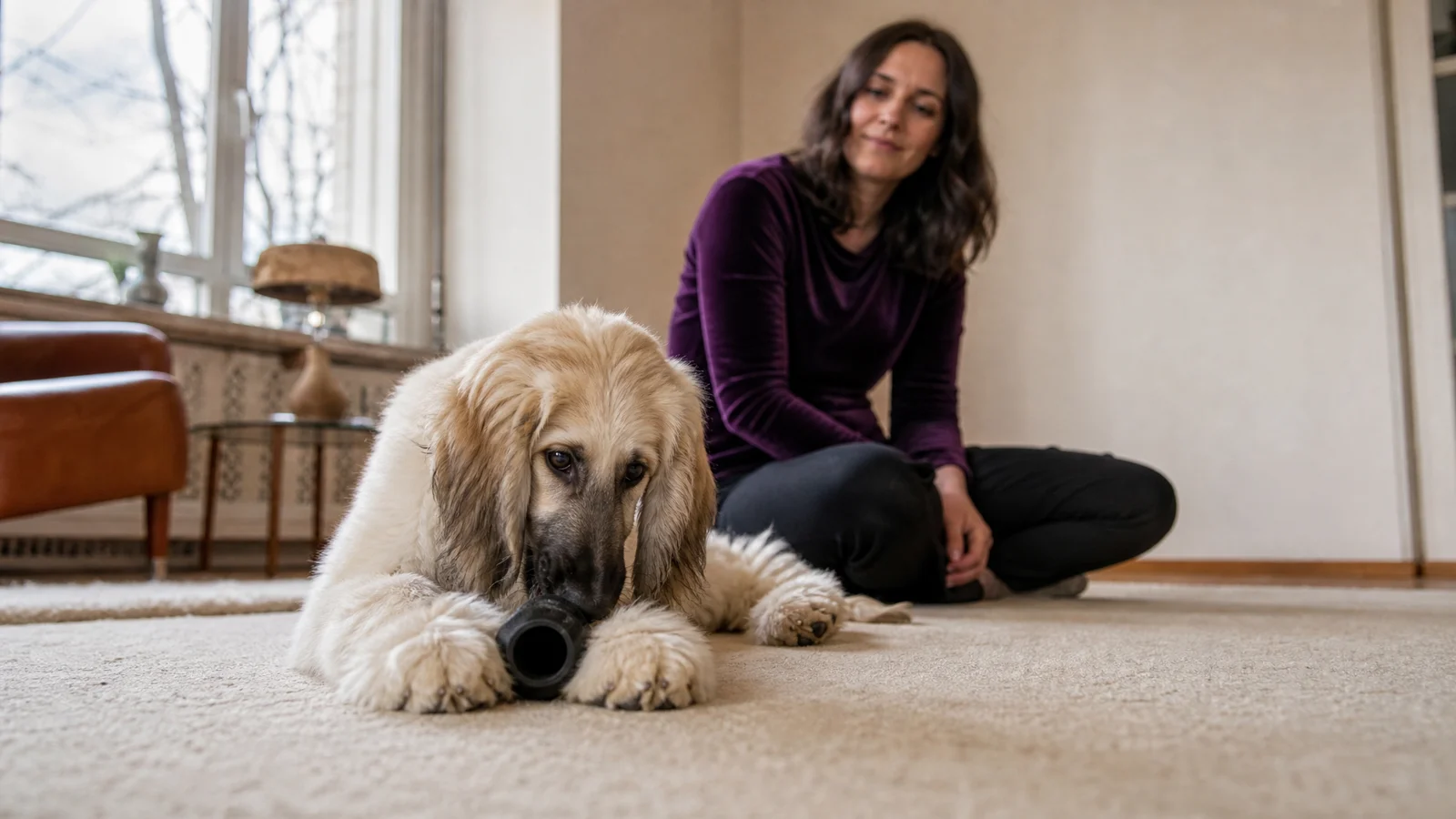
An Afghan Hound puppy at 3 to 4 months needs you to separate chewing management from cue practice, then make the next appropriate choice easy. A mouth on the wrong object calls for calm interruption and safer access. A puppy who can participate comfortably may be ready for one familiar, reward-based task.
The object and setting matter more than a guess about motive. Chewing during a lesson does not prove defiance, and it does not prove that teething explains every difficult repetition. Our training team would first secure the environment, observe what changed and decide whether the puppy needs an outlet, an easier task or professional advice.
This guide follows that decision from the home environment to a small change of place. It does not set a deadline for skills or claim an Afghan-specific teething date. It gives you a way to protect the puppy, preserve appropriate chewing choices and learn which context supports useful participation.
Afghan Hound Puppies at 3 to 4 Months Are Still Learning
The Texas A&M School of Veterinary Medicine describes 3 to 6 months as the juvenile stage for puppies in general. That broad range is developmental context, not a promise about when an Afghan Hound will master a cue or stop exploring with their mouth. Judge the puppy in front of you rather than treating the calendar as a scorecard.
The United Kennel Club describes the Afghan Hound as an independent thinker who can be exuberant and playful with family. That breed description can help you expect an individual response instead of automatic compliance, but it cannot diagnose a pause, predict a chewing episode or explain discomfort. Keep the immediate question narrow: what is the puppy doing, where and with what object?
Read the Puppy’s Chewing Context
Begin by preventing continued access while you look at the whole scene. Notice whether the puppy found an unsuitable household item, left an easy task for an appropriate toy or shows a change that makes eating, drinking or settling seem difficult. One observation is not a diagnosis. A sudden or concerning change belongs with your veterinarian, while a familiar access problem belongs with management.
| Observed context | Immediate management | Specialist owner |
|---|---|---|
| The puppy reaches a loose household object | Block access and offer an appropriate alternative | Household manages the environment |
| The puppy chooses a suitable chew during practice | Pause pressure and allow the safe choice | Household decides when to invite another easy task |
| Mouth discomfort or behavior changes suddenly | Stop the lesson and keep the puppy comfortable | Veterinarian assesses the individual puppy |
| A cue works in one room but falls apart elsewhere | Restore secure management and simplify the setting | Reward-based trainer helps adjust the learning context |
Use the table as a routing tool, not as a way to label the puppy. If you are uncertain whether an object is safe to chew, remove it and ask your veterinarian rather than experimenting. Regular veterinary visits also give you an appropriate place to discuss mouth changes and any concern about comfort.
Make the Next Puppy Choice Easier
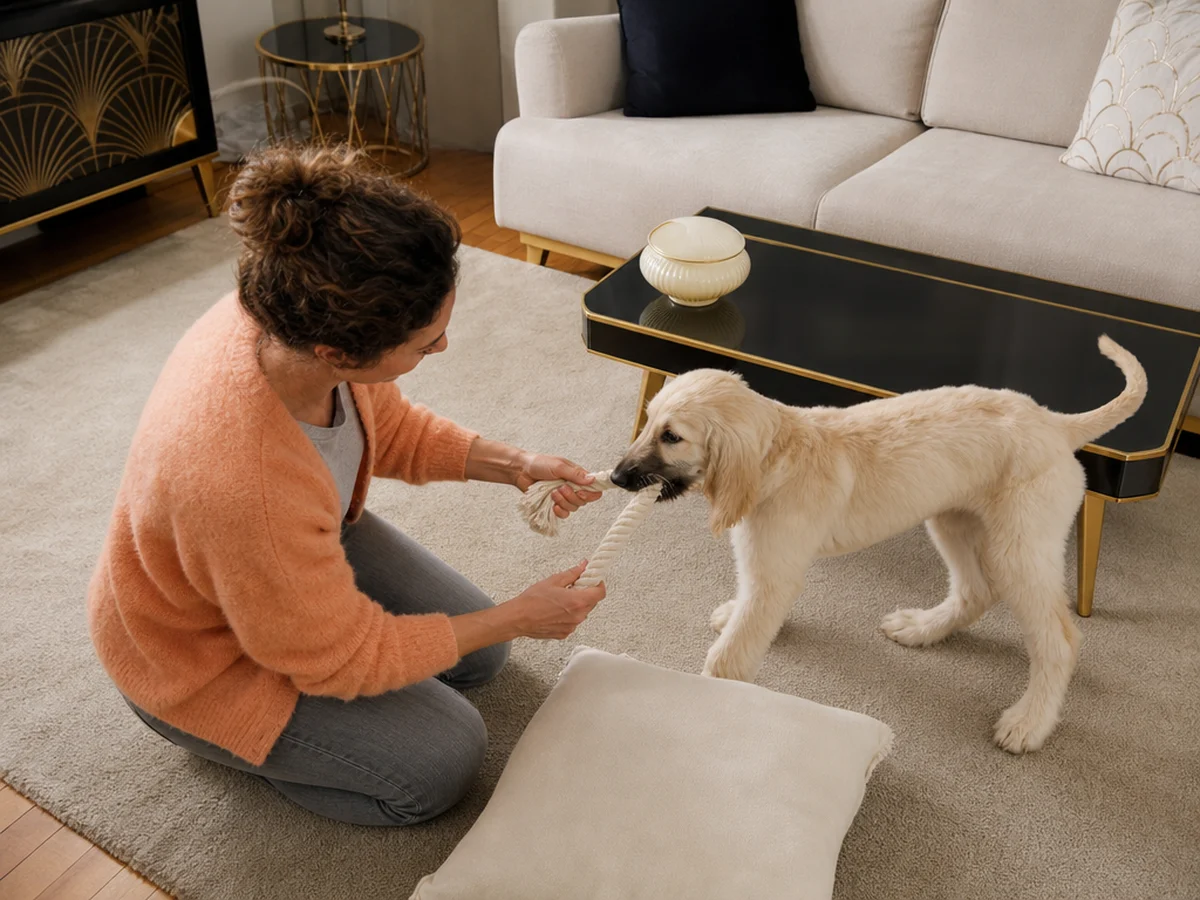
When the puppy has an unsuitable object, calmly prevent further access and present a safe alternative. PDSA advises calmly shifting the dog from the unsuitable item to a safe toy, then praising the appropriate choice instead of using punishment. The lesson is not a contest over the original object. It is a change in access followed by a choice the puppy can succeed with.
Supervision makes that easier because it lets you intervene before repeated chewing becomes the activity. Put tempting items away, use a puppy-safe area and keep an appropriate option available. If the puppy moves to that option, let the useful choice work for them instead of immediately asking for a string of cues.
This page does not replace a full biting or destructive-chewing plan. Its job is to help you decide what comes first during this age window. For nearby routines, Afghan Hound toilet training shows how to organize another supervised puppy task without turning this stage guide into a second housetraining lesson.
An Afghan Hound Puppy Can Learn in More Than One Place
A familiar cue at home and the same cue in a different setting are not identical learning problems. New sounds, surfaces, distance and movement can all compete with the task. Keep a secure leash or barrier where it is needed, and treat a weaker response as information about the context rather than proof that the puppy has forgotten everything.
Move only when the puppy can eat, explore and reorient comfortably in the current area. The goal is not to collect locations. It is to discover whether a very small environmental change still leaves enough attention for one easy behavior.
A Familiar Quiet Area
Start where the puppy has already shown that they can engage. Choose one familiar cue, prepare a valued reward and remove loose objects that would require constant interruption. Blue Cross explains that a distinct marker can predict a valued reward, so mark the wanted response and deliver the reward promptly.
Keep the result specific. You learned that this cue was available in this place under these conditions. You did not prove that the puppy should perform it anywhere, and you did not establish a monthly milestone.
A Small Change of Setting
Change one feature, such as moving to a nearby room or increasing distance from a doorway, while keeping safety controls in place. Invite the same easy cue once the puppy has looked around. If they cannot reorient, increase distance from the distraction, return to the familiar area or end the practice without punishment.
Handling work deserves the same context check. The approved Afghan Hound handling practice guide owns the complete paw-and-ear routine, while this stage page contributes only the decision to make the setting easier when participation changes.
A General Practice Cycle for the 3-to-4-Month Puppy
Use this general approach after you have managed unsafe access and decided that the puppy is comfortable enough to learn. Select one easy task instead of building a long lesson. Your marker tells the puppy which choice earned the reward, while your next decision reflects whether the setting helped or hindered that choice.
A successful cycle can be brief without being rushed. There is no required number of repetitions, and stopping after useful information is not failure. If the puppy leaves for an appropriate chew, seems uncomfortable or cannot engage, respond to that context rather than making the cue louder or more demanding. When the task remains appropriate, follow this general practice approach.
- Select one familiar, easy behavior that fits the current place.
- Invite the behavior with the cue the puppy already knows.
- Mark the wanted choice at the moment it happens.
- Reward with something the puppy values in that setting.
- Reassess the puppy and either repeat simply, make the context easier or finish.
The cycle is a decision aid, not a performance quota. It keeps management ahead of practice and gives you a clear exit when the puppy's mouth, attention or comfort points to a different need.
Afghan Hound Teething-Stage Questions
The body explains how to route common situations, but it does not settle every household decision or trainer conversation. These questions fill those remaining gaps without turning one puppy's response into a breed rule.
- Can household members practice different easy cues?
- Yes, if each person uses clear cues, rewards the behavior they ask for and keeps the setting manageable. Share which words and gestures belong to each behavior so the puppy is not asked to solve conflicting signals, and compare the places where participation was easiest.
- Should the lesson pause when the puppy leaves to chew a suitable toy?
- Often, allowing the appropriate choice is more useful than competing with it. Confirm that the item is safe for this puppy, supervise as needed and invite another easy task later only if the puppy is comfortable and available.
- What information helps a trainer when the puppy responds at home but not in class?
- Describe the exact cue, reward, distance, noises and movement present in each setting. Ask the trainer to help reduce the difference while keeping the puppy secure, rather than concluding that the puppy is stubborn or raising the difficulty.
Keep a Record of the Puppy Context That Worked
Write down the place, the easy task and what happened immediately before the puppy participated. Also note whether access management, an appropriate chew or greater distance from a distraction made the choice easier. That record is more useful than a vague note that the session was good or bad.
Carry forward one context that supported comfort and learning, not a demand for a longer session next time. As the puppy changes, the useful combination of place, task and reward may change too. Your record helps you adjust without inventing a deadline or mistaking one difficult setting for the puppy's overall ability.
 Training basicsHow to Teach an Afghan Hound to Heel
 Puppy trainingAfghan Hound Puppy at 4 to 6 Months: What Changes
 BehaviorHow to Fix Afghan Hound Separation Anxiety