 Afghan Hound
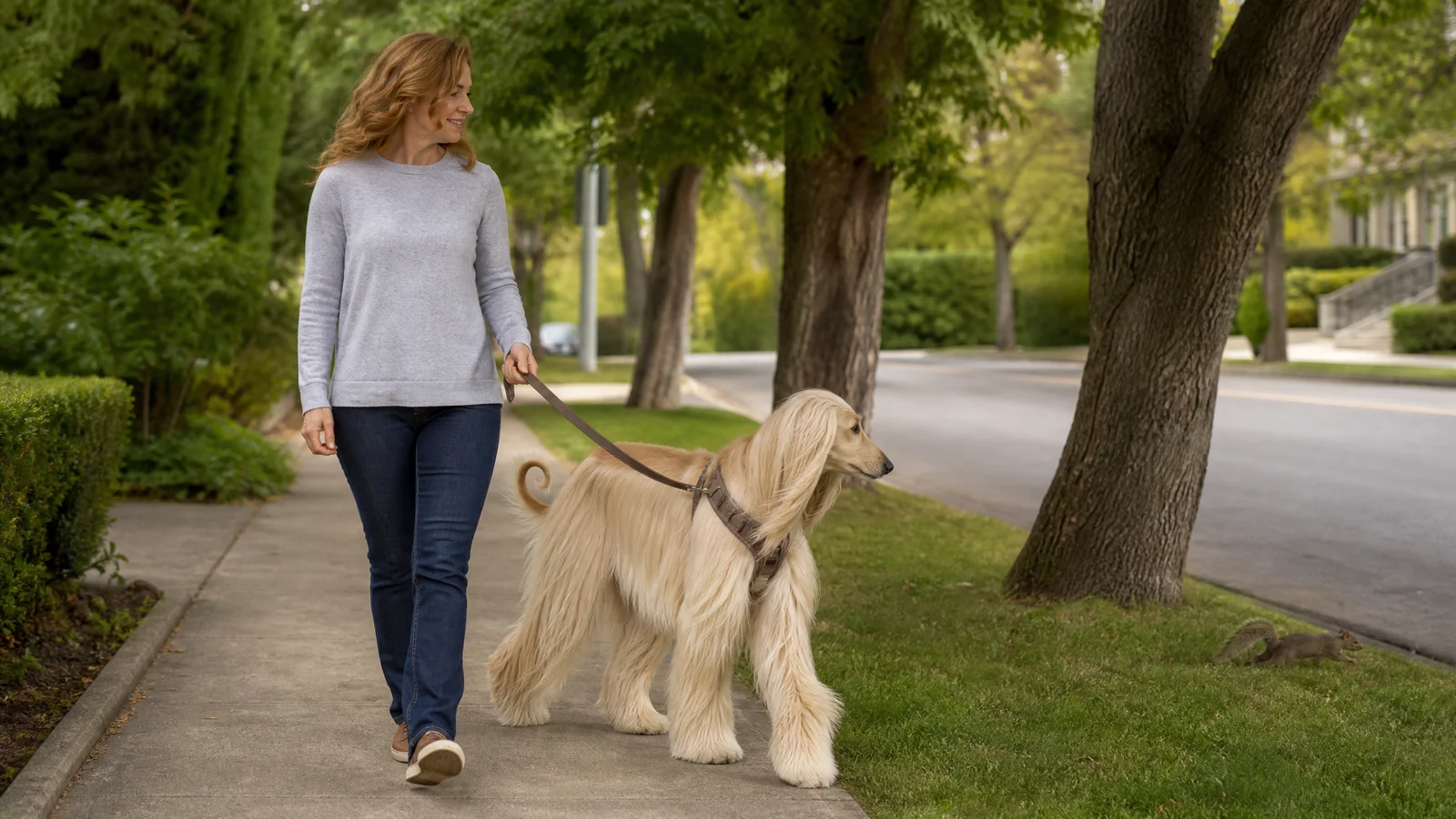
An Afghan Hound spots a squirrel, bicycle, or running dog before the handler has finished deciding whether to cross the street. The leash tightens, the dog accelerates, and an elegant walk becomes a contest of speed and balance. That scene is predictable for a speed-focused visual hunter whose attention follows motion, not evidence that the dog has forgotten every lesson.
We treat loose-leash walking as a set of scenarios rather than one command. This guide covers equipment for a long coat, the ordinary pull toward a destination, the sudden lunge at movement, safe practice beyond the sidewalk, and a post-walk debrief that tells you what to train next. Each debrief should leave you with one concrete adjustment for the next outing.
Afghan Hound Leash Training
The breed standard describes an Afghan Hound galloping when free and moving at a fast trot on a loose leash. That athletic movement affects the job. The goal is not a rigid show-ring position. A useful result is a dog who can travel with a soft line, reconnect around manageable distractions, and remain securely attached when instinct arrives faster than a cue.
Equipment Under a Moving Coat
Fit the harness in a quiet room. The long coat can hide a twisted strap, trapped hair, or rubbing behind an elbow, so slide your fingers under each contact point while the dog stands and walks.
Check the top line and chest from the side, then inspect the coat again after the outing. Choose secure equipment that stays stable without restricting a natural stride.
The Reward Zone Is a Location
Pick a side and deliver rewards near your leg whenever the line softens. Placement matters because feeding out in front can pull the next step forward. Begin in a hallway, driveway, enclosed yard, or empty stretch of sidewalk where the Afghan can notice your movement without competing with fast traffic.
Mark check-ins, pace changes, and voluntary returns to the reward zone. A dog does not need to stare at the handler continuously. Sniffing and looking are part of a useful walk, provided the line remains manageable and the dog can reconnect. Alternate a few connected steps with permission to investigate an appropriate spot.
Keep the first outings short enough to end with coordination intact. Leash practice is not the breed's full exercise outlet, so schedule secure running separately. Trying to tire an Afghan while simultaneously teaching careful walking asks the same route to do two conflicting jobs.
Leash Training Through Everyday Pulls
Ordinary pulling builds gradually. The dog wants the tree, smell, gate, or next block, and forward movement rewards tension. The training answer is consistent access control. Tightness pauses the trip.
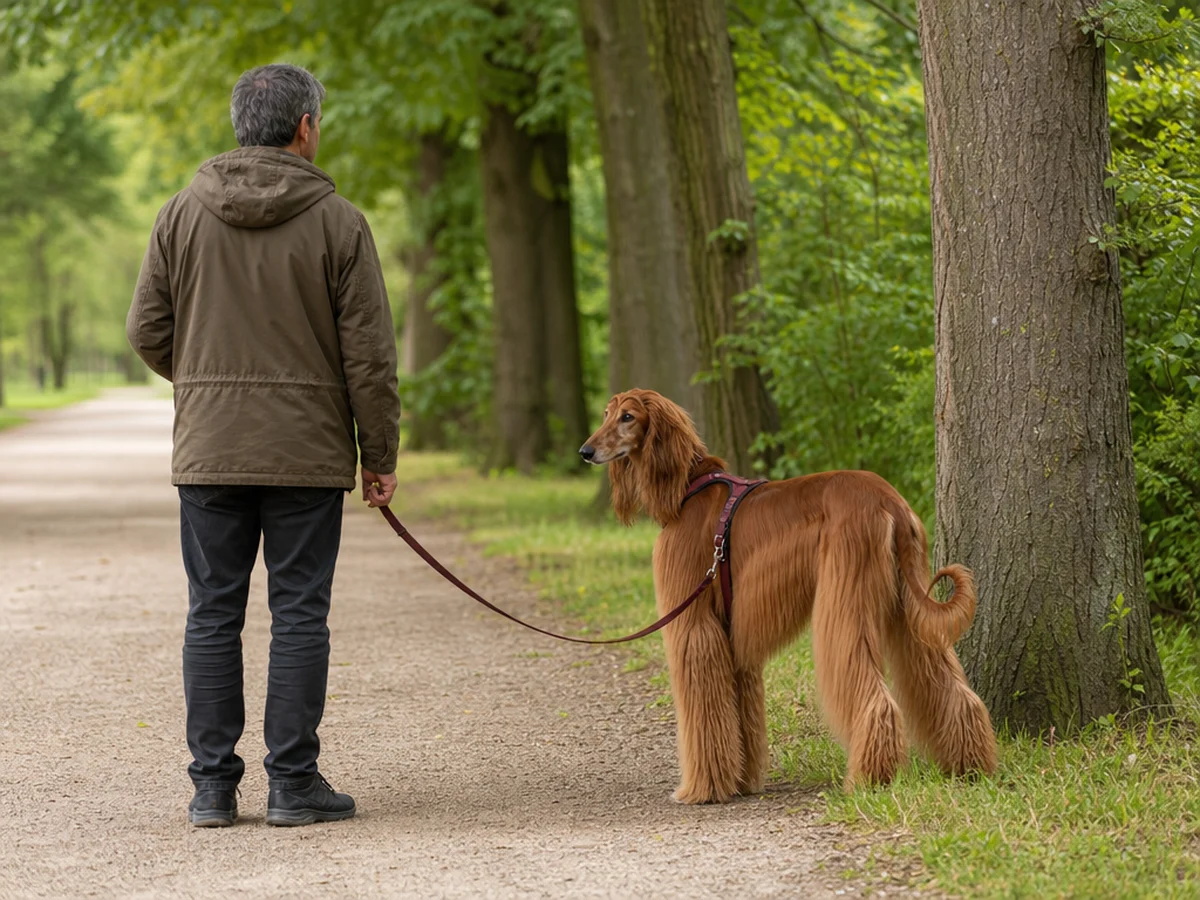
Slack makes movement possible again. This scenario is different from a sudden reaction, so identify it before choosing the response.
Scene One Has a Tight Line
Scene. The Afghan leans toward a smell and the leash becomes firm, but their body can still turn and their attention is not locked on fast movement. Action. Stop without pulling back.
Wait for the dog to shift, look back, or create slack, mark that moment, and move forward. The PDSA pulling guide uses the same stop-and-wait principle.
If the dog remains planted, take a calm step in another direction or invite a familiar hand target. Reward the first soft step with you. Do not wait for a perfect heel before resuming. The lesson is a simple equation that can survive real walks: pressure stops access and a loose line restores it.
Consistency Is the Whole Mechanism
The Best Friends guidance emphasizes stopping every time rather than allowing pulling to work occasionally. Apply the rule at doors and gates too. Reward a brief pause, open only while the leash remains soft, and reset if the dog surges. Family members need the same response or the Afghan will keep testing the version that sometimes reaches the reward faster.
Leash Training Through Sudden Lunges
A lunge at movement is not merely stronger pulling. The dog may be trying to chase, approach, or create distance, and attention can narrow before the leash tightens. In that scenario, safety and space come first. Training begins only after you have created enough distance for the Afghan to eat, turn, and move with you.
Working Distance Comes Before Cues
Scene. A scooter appears ahead and the dog's head lifts, body lengthens, and pace quickens. Action. Cross early, turn into a driveway, step behind a visual barrier, or reverse direction.
Reward the first glance back after the trigger is noticed. Do not wait for barking or a full launch before deciding the route is too hard.
Begin the next practice farther away than the point where the dog struggled. Let the Afghan notice the movement, mark a calm orientation back toward you, reward, and leave while the response is still possible. Over later outings, distance can decrease gradually. The purpose is not to march closer every session, but to build many successful observations.
Notice the direction of the dog's effort. A dog pulling forward to reach something needs a different route from a dog trying to retreat. In both cases, give space rather than holding the dog in place while the trigger passes closely. A stationary dog at the end of a tight leash may look controlled while becoming more distressed or excited.
The Emergency Turn Is Rehearsed Early
Practice a cheerful turn cue where nothing surprising is happening. Say the cue, pivot away, and reward the dog for catching up. Change direction and starting position across short sessions. When a real trigger appears, the cue should predict a familiar route out rather than becoming a new demand delivered at the hardest moment.
Scene. A loose dog or bicycle appears too close for planned distance. Action. Use the rehearsed turn, move behind the nearest safe barrier, and feed several small rewards while leaving if the Afghan can eat. If the dog cannot respond, keep moving to safety and make the next route quieter. Management during a surprise is not a failed training session.
When Leash Training Leaves the Sidewalk
Recall practice does not erase the need for a leash. The breed standard shows how much ground this hound can cover when free, and chase can carry the dog away before a response is completed. Use secure fencing for free running and keep ordinary open-space outings attached.
A Long Line Adds Space, Not Security
A long line can create room for recall games in a clear, legal area, but it is not a portable fence. Clip it to secure, well-fitted equipment. Choose ground without bikes, dogs, people, brush, posts, or other obstacles that could catch the line. Feed and gather it smoothly, never wind it around a hand or body part, and leave before the location becomes crowded.
- Before the session. Inspect the clip, line, harness fit, coat contact, ground, exits, and movement around the area. Decide where you will shorten the line before anyone passes.
- During the session. Reward orientation, short returns, and moving with the line rather than waiting for the dog to hit the end. Release to sniff again when that is safe.
- After the session. Check the coat and feet, note which distance kept responses easy, and provide quiet recovery. Long-line work adds freedom and mental effort even without a full-speed run.
Rehearse the Doorway Before the Route
Protect the exit ritual at home. Put on equipment before opening the exterior door, reward a soft line, and step out together.
If excitement is too high, close the door and create an easier repetition rather than spending the first block being towed. Practice with the door opening only a few inches before the real walk, and vary which family member handles the leash while keeping the same rule. Use the same calm order on return: water, equipment off, coat check, and rest.
Keep regular veterinary visits on the calendar. Speak with your veterinarian if a dog who walked comfortably suddenly resists equipment, changes gait, avoids turning one direction, or reacts sharply to touch. A sudden physical change is not a cue-training problem. Pause the walking plan until the dog has appropriate guidance.
Run one baseline comparison. If the leash was soft indoors and tight outside, the environment changed faster than the lesson. Return to a quieter route, improve the reward, and ask for fewer connected steps.
Repeat the indoor version once to confirm the cue still works, then try an exterior location with less movement and more room. The wider Afghan Hound training roadmap explains how to move a known cue through one new variable at a time.
The Afghan Hound Walking Debrief
The dog pulled only near movement. Treat the next outing as a distance scenario, not a stop-and-wait drill. Scan farther ahead, change sides of the street sooner, and rehearse the turn where success is easy. Understanding Afghan Hound temperament helps set realistic expectations for an independent visual hunter.
The puppy needed a bathroom trip. Keep that route direct and reward outdoor success before adding walking practice. A few calm steps can follow, but do not make perfect leash manners the price of relief. The Afghan Hound potty training handbook keeps the schedule and reward timing clear.
- Surface and setting. Record whether the route was a quiet sidewalk, busy corner, trail edge, parking area, or building exit. Note weather and visibility because wind, darkness, and wet ground can change how early the Afghan detects movement.
- Trigger and distance. Name the moving object and estimate where the dog first changed posture, not only where the lunge occurred. The useful training distance begins before the obvious reaction.
- Your action and result. Write whether you stopped, turned, crossed, used a barrier, or fed in place. Note which action restored a soft body and which one left the dog fixed on the trigger.
- Recovery after the scene. Record how readily the Afghan could sniff, eat, walk with slack, or settle at home. Fast recovery may support repeating the setup, while prolonged alertness argues for an easier route next time.
The dog stayed alert after returning. Review whether the route was too busy, the walk replaced a needed run, or the household skipped the normal recovery sequence. More distance and a shorter outing may help more than adding another block. Record the trigger, response, recovery time, and what you will change once.
Know When Afghan Hound Leash Training Needs Help
The handler could not stay safe. Seek an experienced trainer whose work relies on rewards and careful observation when pulling risks a fall, lunging puts people or animals at risk, or fear prevents the dog from recovering at workable distances. Hands-on observation can address timing, route design, and equipment without turning the leash into a contest.
A soft leash does not prove that chase instinct has disappeared. It shows that the equipment, distance, route, reward, and practiced actions gave the Afghan Hound a workable choice in that scenario.
Debrief the walk you actually had, change one condition, and carry the successful pieces into the next one.
 BehaviorSocializing an Aloof Afghan Hound Puppy Without Shyness
 CareHow to Teach an Afghan Hound Puppy to Love the Brush
 BehaviorAfghan Hound: Sensitive to harsh tones