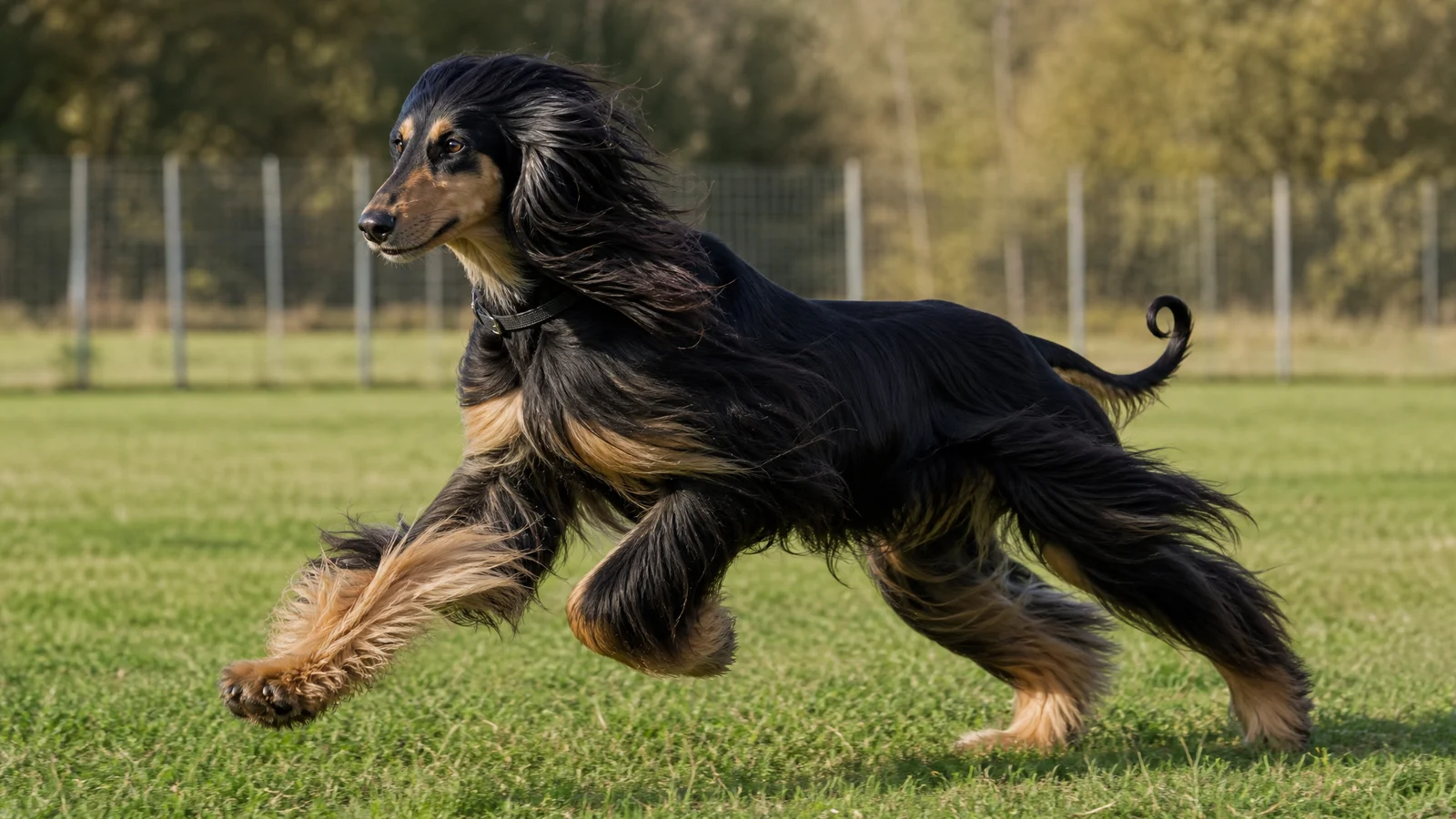
 Afghan Hound
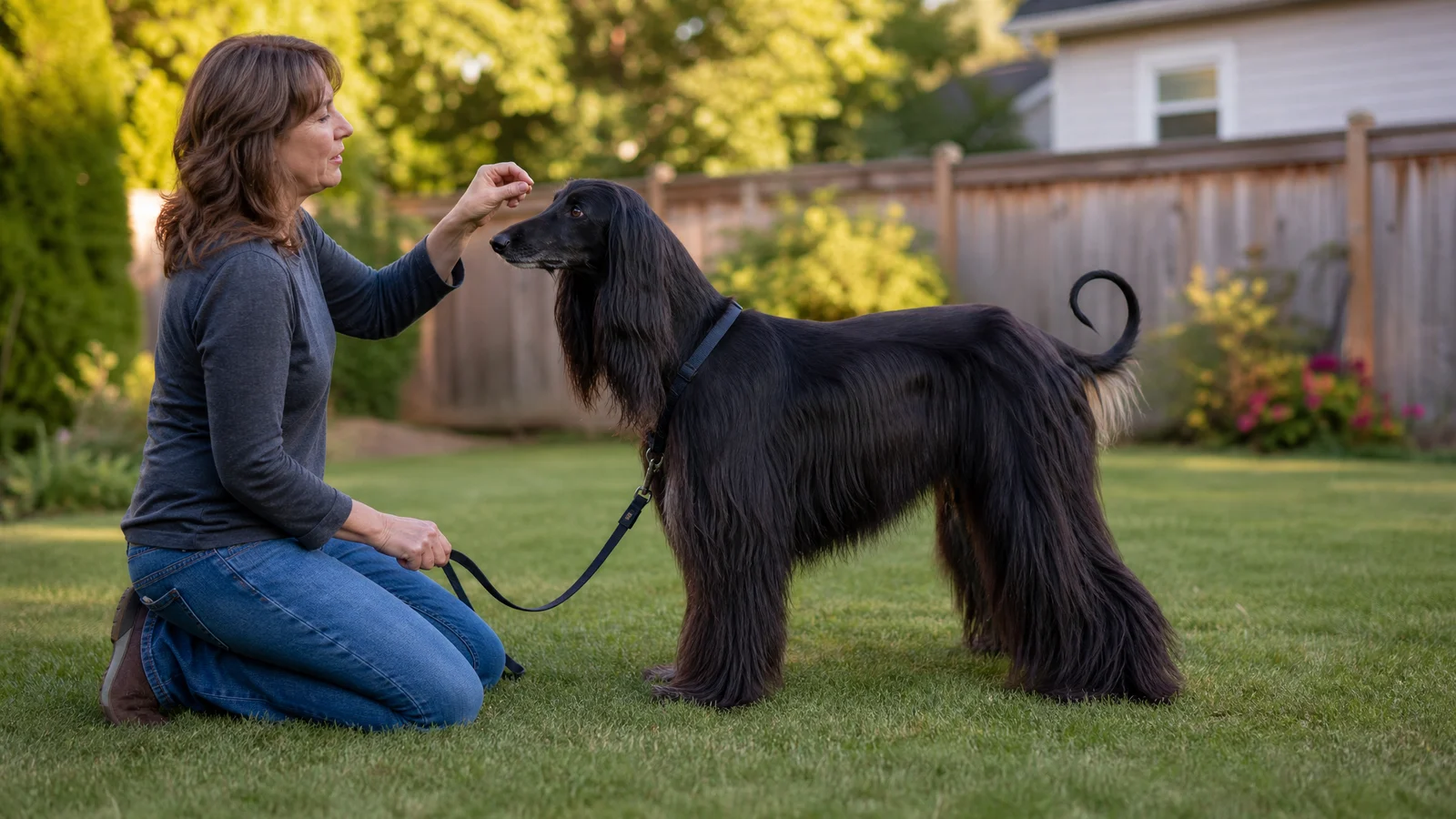
Can an Afghan Hound be trained? Yes, but the better question is whether the training plan gives this independent sighthound a clear reason to participate. Repetition without purpose often creates delay rather than reliability. The successful roadmap combines worthwhile rewards, secure management, small lessons, and expectations suited to a dog developed to make decisions at speed.
We begin with the household skills that protect everyday life, then move each skill outward one variable at a time. This guide maps that order from the first marker and name response through handling, leash work, alone time, and real-world practice. It also shows how to recognize progress without pretending that chase instinct has disappeared.
The Afghan Hound Training Contract
The breed is described as strong-willed, dignified, and independent. Those words do not mean unable to learn. They mean attention cannot be taken for granted.
Our side of the contract is to make the task understandable, pay promptly for the right choice, stop before interest collapses, and keep the environment safe enough that mistakes do not become dangerous adventures.
Independence Changes the Bargain
The breed description presents an independent thinker who may be aloof with strangers and playful with family. That combination favors brief lessons with a visible payoff. Ask once, make the setup easier if needed, mark the correct response, reward, and pause. Repeating a cue while the dog looks elsewhere only teaches that the early versions are optional background noise.
Reward value changes with context. Food may be compelling in the kitchen and irrelevant near a running squirrel. Build a menu that includes food, a toy if the dog enjoys it, permission to sniff, opening a door, beginning a walk, or release to a secure run. The reward-based guidance explains that behavior followed by something the dog likes becomes more likely to recur. The Afghan decides what is valuable at that moment.
Start Afghan Hound Training in a Small Classroom
A quiet room, fenced yard, or empty corner of a familiar place lets the dog discover the rule without competing with every moving shape. Difficulty has separate parts: location, distance, duration, distraction, and the handler's position. Raise only one at a time. If the response slows, return to the last version that was easy instead of adding pressure.
A Marker Makes the Answer Precise
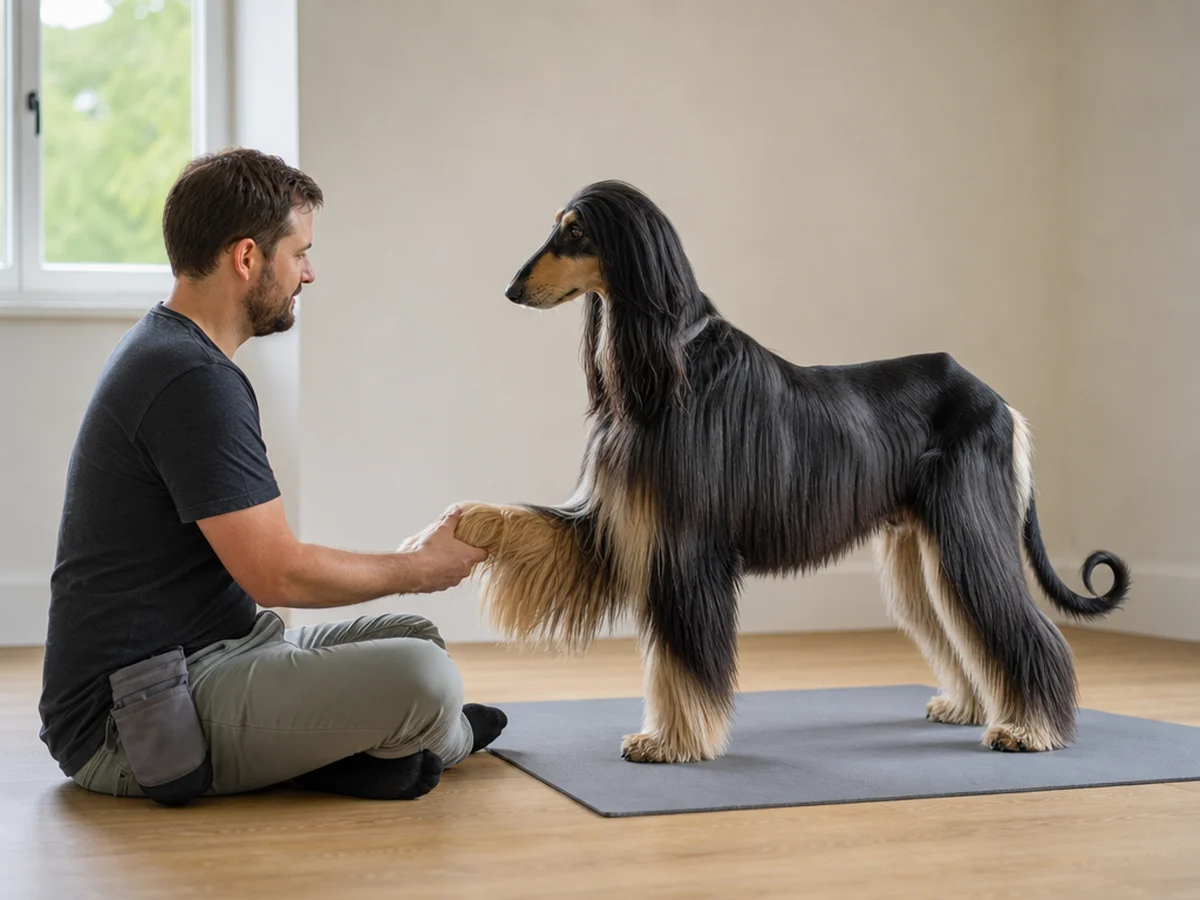
Choose one short word or sound that always predicts a reward. First pair the marker with food until the connection is clear. Then use it at the exact moment the dog turns toward their name, steps onto a mat, lets you touch a paw, or creates slack in the leash. Deliver the reward promptly so the marker keeps its meaning.
Build a cue in layers. Capture or guide the action, add the spoken cue when the movement is predictable, then practice in a second room. Change your posture and position so the dog is responding to the cue rather than one fixed picture. Only then add a mild distraction. A cue is not finished merely because it works beside the treat container. Record which version is reliable before advancing the roadmap.
Training Priorities for the First Month
Trying to teach everything at once produces a dog who has sampled many exercises and mastered none. Put safety and household function ahead of performance. Each priority below supports several later skills, so progress compounds rather than scattering across unrelated tricks.
Build the Foundation in This Order
Move down the roadmap only while the earlier layer remains usable. Continue practicing old layers in ordinary life after a new one begins. A puppy can start with tiny versions, while an adult newcomer may need the same sequence with more management and a slower transition between settings.
Seven Skills That Carry the Roadmap
- Name response and check-in. Reward the dog for turning toward you. This becomes the doorway to every later request and a way to reconnect before the environment takes over. Practice from different positions so the response does not depend on you standing beside the reward pouch.
- Marker and hand target. Teach the dog how correct choices are identified, then give them a simple movement that can guide turns, handling positions, and transitions. Move the target only a small distance at first, and reward before speed turns the exercise into grabbing or chasing.
- Mat and release. Build a place to settle during meals, visitors, coat care, and quiet household activity. Begin with approaching and standing on the mat before expecting a long rest. Release clearly so staying and leaving do not blur together.
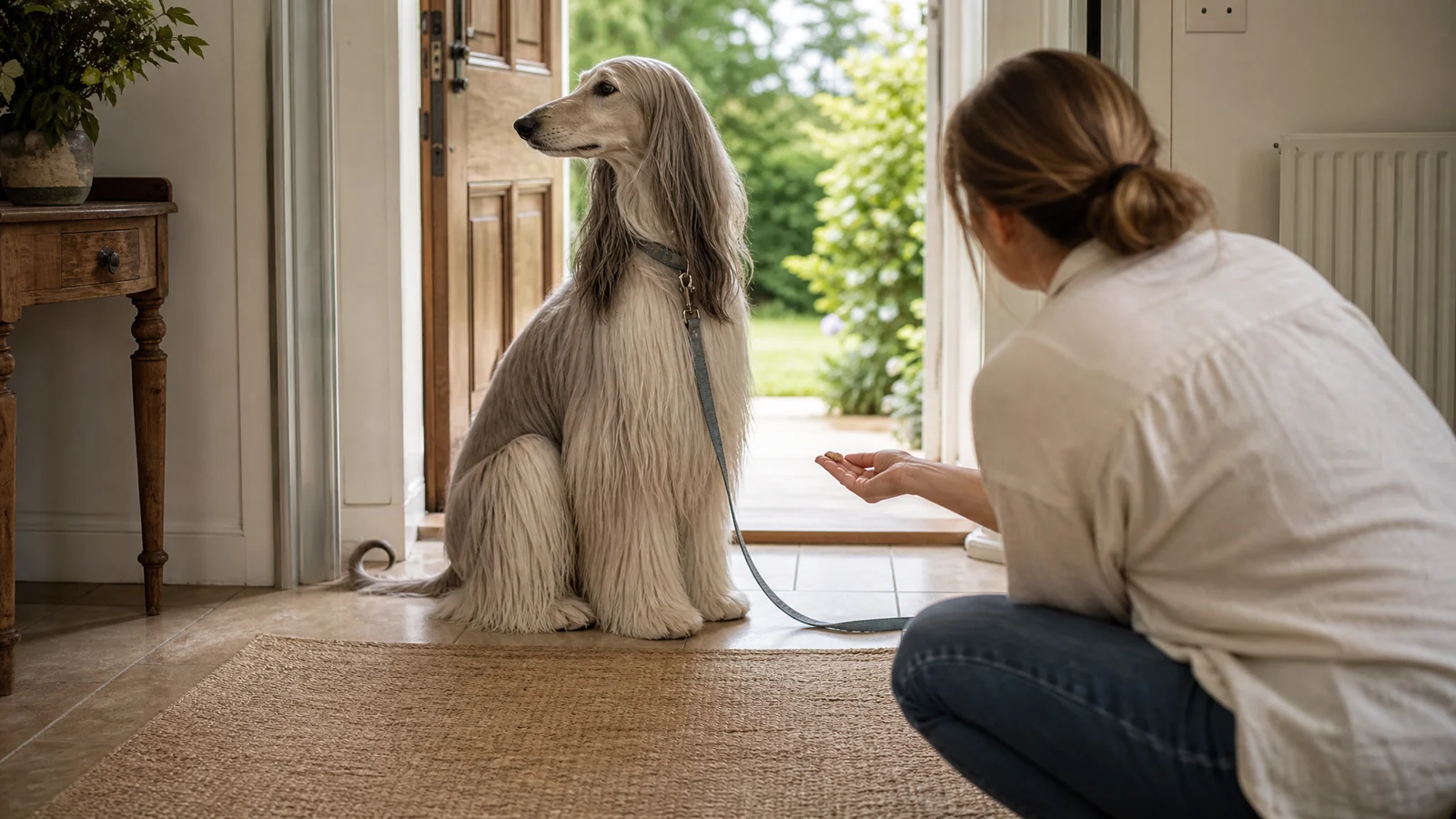
- Door and gate habits. Reward waiting, clip the leash before access opens, and preserve secure boundaries. Practice at interior doors before adding the excitement of the yard or sidewalk. Management remains important even after the ritual looks polished.
- Handling and walking skills. Add cooperative coat checks, harness fitting, slack-leash movement, and brief recall games inside enclosed spaces where chase cannot override safety. Keep each handling turn short enough that the Afghan can remain an active participant rather than merely endure it.
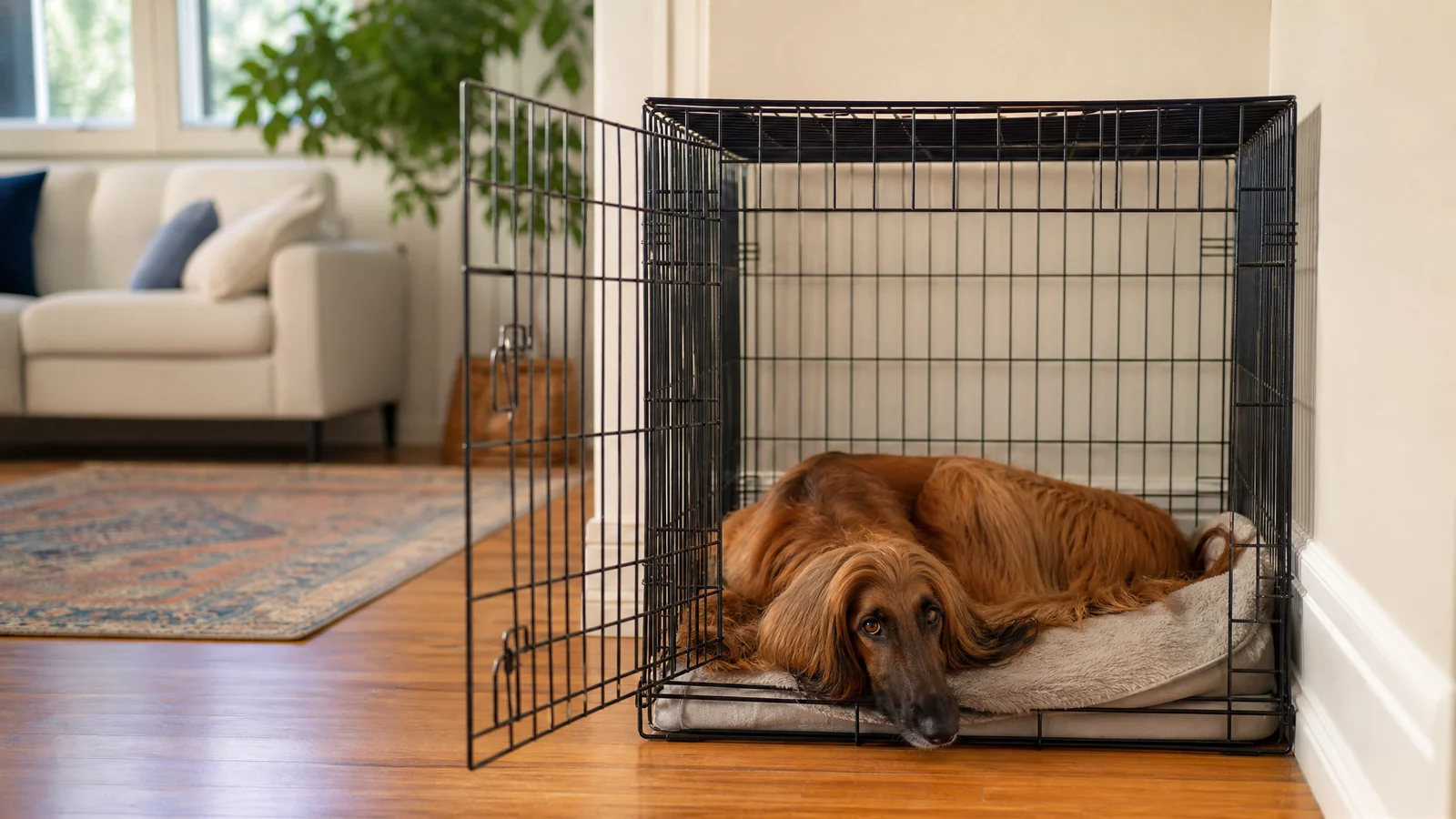
- Quiet independence. Reward resting behind a gate or in a prepared area while you move nearby. Add distance before duration, and return before concern becomes panic. Comfort while you are visible is the first layer, not proof that a long departure is ready.
- Generalization and recovery. Repeat familiar skills in one new place at a time, then provide a real break. A dog who can perform, settle, and return to normal activity is learning a more durable pattern than a dog pushed through continuous repetitions.
Keep Housetraining and Alone Time in Parallel
Housetraining and alone time run alongside this sequence rather than waiting at the end. Take a puppy out on a predictable schedule and reward outdoor success immediately. Build crate or gated-area comfort while you remain nearby before adding real absence. The dedicated Afghan Hound potty training and crate training plans give those routines the space they require.
Afghan Hound Training Leaves the House
Indoor success proves that the dog understands one version. It does not prove fluency on a sidewalk full of smells and movement. Begin outside in the easiest available location, use a reward that still matters there, and ask for a familiar action. If the Afghan cannot respond, add distance or go back inside. The environment became harder, not the dog more stubborn.
Leash skills need their own progression. Reward near your chosen walking position, pause when the leash tightens, and resume when slack returns. Practice a cheerful turn before you need it around a sudden trigger. Equipment should fit beneath the long coat without rubbing or trapping hair, and it should be inspected after outings. The full Afghan Hound leash training playbook covers pulling and lunging.
Do not make open-space freedom the graduation test. The Afghan Hound's speed and chase instinct mean a fence and leash remain responsible safeguards even when check-ins improve. Recall can be practiced on a long line in a clear legal area or inside secure fencing, then rewarded generously. Training improves choices, while management protects the dog when instinct wins.
Fit Training Into Ordinary Life
Formal sessions are only part of the roadmap. Ask for a name response before placing a meal, a moment of slack before moving forward, a stand while checking the coat, or a mat settle while dinner is prepared.
Keep the request proportionate to the reward. Waiting briefly for a door is fair, while demanding a long performance every time ordinary life resumes can make the cue less valuable. These tiny repetitions connect the lesson to outcomes the dog already values and keep practice from becoming a separate chore.
Exercise, Rest, and Lessons Share a Calendar
An Afghan with unused physical energy may struggle through slow work, but exhaustion is not the answer. Schedule safe running separately, use walks for sniffing and public skills, and place harder thinking tasks when the dog is alert but not frantic. After activity, allow genuine quiet. A dog who never gets a predictable off switch has little chance to rehearse settling.
Coat care deserves daily training attention. Start on an easy, untangled area, mark one calm touch or brush stroke, reward, and release. Gradually add duration and more sensitive locations. Do not wait for a difficult tangle to teach cooperation. A history of easy handling also helps with routine examinations and equipment checks.
Keep regular veterinary visits in the calendar. A sudden change in willingness to move, accept touch, eat rewards, or perform a familiar action may reflect discomfort rather than a training gap. Pause the lesson and speak with your veterinarian instead of trying to work through an abrupt change.
Training Errors That Cost Cooperation
The first error is treating reserve as defiance. Rushing, crowding, or making the task harder when the dog disengages usually reduces useful information. Ask whether the cue was learned in this setting, whether the reward still matters, and whether the Afghan can physically and emotionally perform. Then simplify one variable and try again.
The second error is inconsistency in what earns access. If pulling sometimes reaches a smell, waiting loses value. If a gate sometimes opens while the dog surges, the calm ritual becomes unreliable. Family members should use the same cues, marker, release word, and safety rules. Consistency is not severity. It is a predictable path to success.
The third error is training through fear or shutdown. A dog who freezes, retreats, or stops taking a familiar reward needs distance and an easier task. The AVSAB position statement recommends reward-based methods for dog training. An open-access companion-dog study also found poorer welfare signs in schools relying more heavily on methods built around discomfort. Trust is part of performance, not an optional extra.
Proof the Roadmap Is Working for Your Afghan Hound
Progress appears first as fluency in ordinary moments. The dog turns toward their name more often, expects the marker to mean something, offers slack near the start of a walk, settles after activity, and accepts short handling steps. Responses may still slow in a new setting. The difference is that you now know which variable to reduce.
Track functions rather than a long cue count. Can the Afghan move safely through a doorway, reconnect with you around mild movement, rest in a chosen place, tolerate necessary coat checks, and recover after an exciting outing? Those abilities matter more than performing many tricks in one quiet room.
Bring in a qualified reward-based professional when fear, panic during absence, intense guarding, or lunging puts the dog or people at risk, or when repeated simplification does not restore learning. Choose someone who can observe the full setup and coordinate with your veterinarian when behavior changes suddenly.
The roadmap is not about removing independence. It gives that independent mind a reliable language, valuable outcomes, and secure limits. When the plan is working, the Afghan Hound remains unmistakably themselves while becoming easier to guide through the parts of life where cooperation and safety must meet.
 Training basicsAfghan Hound Trainability: Rewards for a Self-Willed Dog
 Training basicsTeaching an Afghan Hound to Rest Alone in a Crate
 Exercise and jobsWhy Short Walks Fall Short for a Full-Speed Afghan Hound