 Afghan Hound
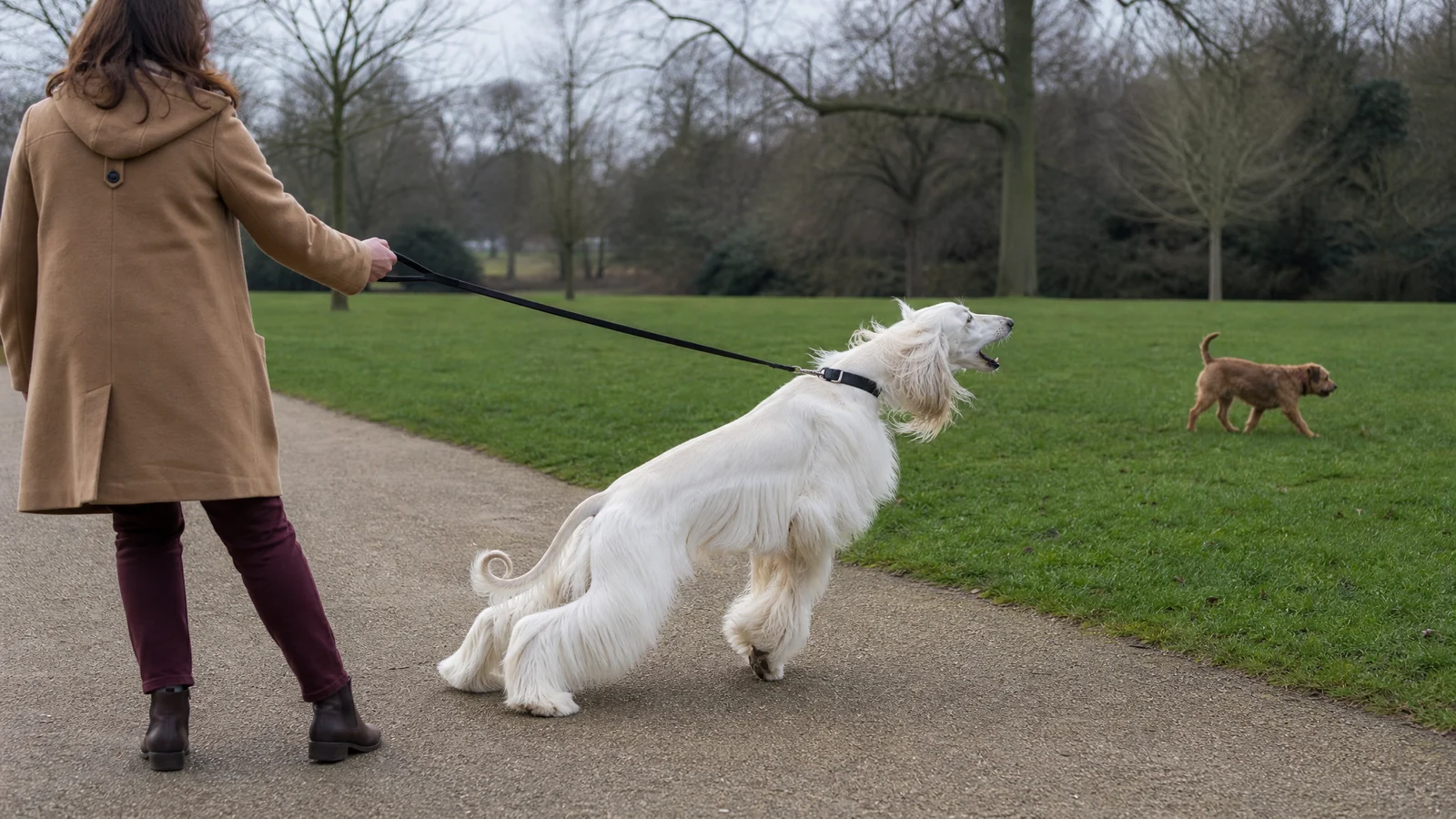
When a stranger or another dog is approaching and your Afghan Hound stiffens, the best move is usually the plainest one: add distance and leave while your dog can still walk with you. One lunge, one burst of barking or one rigid stare can end a walk, and the urgency of that moment is exactly when space does the most good. Further down, we'll look at how to build in distance, where the exits belong and when a professional should take over.
Fear, frustration and chase interest can look alike from the other end of the leash, so the first jobs are safe management and careful watching. Nothing here asks you to confront the trigger or test how close your Afghan Hound can tolerate. What you write down afterward about distance, direction and recovery will serve you better than any label for your dog.
What Is Your Afghan Hound Reacting To?
The United Kennel Club Afghan Hound standard describes a very well-developed chase instinct. That is context for handling around movement, nothing more. It does not explain every lunge, and it says nothing about responses to dogs, people, vehicles or unfamiliar objects that may have little to do with chasing.
Describe the trigger before naming a category. Did it move, approach, appear suddenly or stand still? Then note how far away it was, which way your dog turned and how quickly they settled afterward.
A running animal, a rolling object and an approaching dog all involve motion, yet they can produce different patterns, so keep each one separate in your notes instead of filing everything under one word. Fear, frustration and chase interest also overlap in visible behavior, and you cannot sort them out by moving closer, dropping the leash or arranging an encounter.
Management stays the same while the motive is uncertain: maintain physical security, preserve distance and leave before the choices disappear. A pattern in your notes can help a qualified professional ask better questions, but it should never become a home label for your dog.
Ordinary tension toward a squirrel or an interesting smell is a different job, covered in our guide to Afghan Hound leash walking. Here the concern is the encounter itself, where distance and safety come before a loose leash.
Spotting Afghan Hound Reactivity Before It Peaks
Compare the walk in front of you with your dog's ordinary walking pattern. Stopping to take a usual reward is a good sign that thinking is still possible. Fixing on movement, leaning forward, vocalizing, freezing, scanning again and again or struggling to turn away all suggest the encounter is already past what your dog can manage. Write down what you saw, not what you think was felt, because a body can show a stiff posture but never an intention.
No single signal tells the whole story. A brief glance followed by a soft turn reads very differently from sustained fixation followed by a lunge, and both differ from an Afghan who is trying to retreat. Look at direction, intensity and recovery together.
How the trigger arrived matters too. A gradual approach across open ground gives different information from a person or dog appearing suddenly around a corner.
That detail does not reveal motive, but it can show whether sightlines or surprise changed the point where ordinary walking stopped. When the response is building, use your exit. Move in a broad, safe direction, keep secure handling and avoid forcing a close pass. Demanding sustained eye contact, repeated sits or a formal heel while the trigger keeps approaching only adds work to a dog who is already struggling.
Distance, Exits and Recovery on the Walk
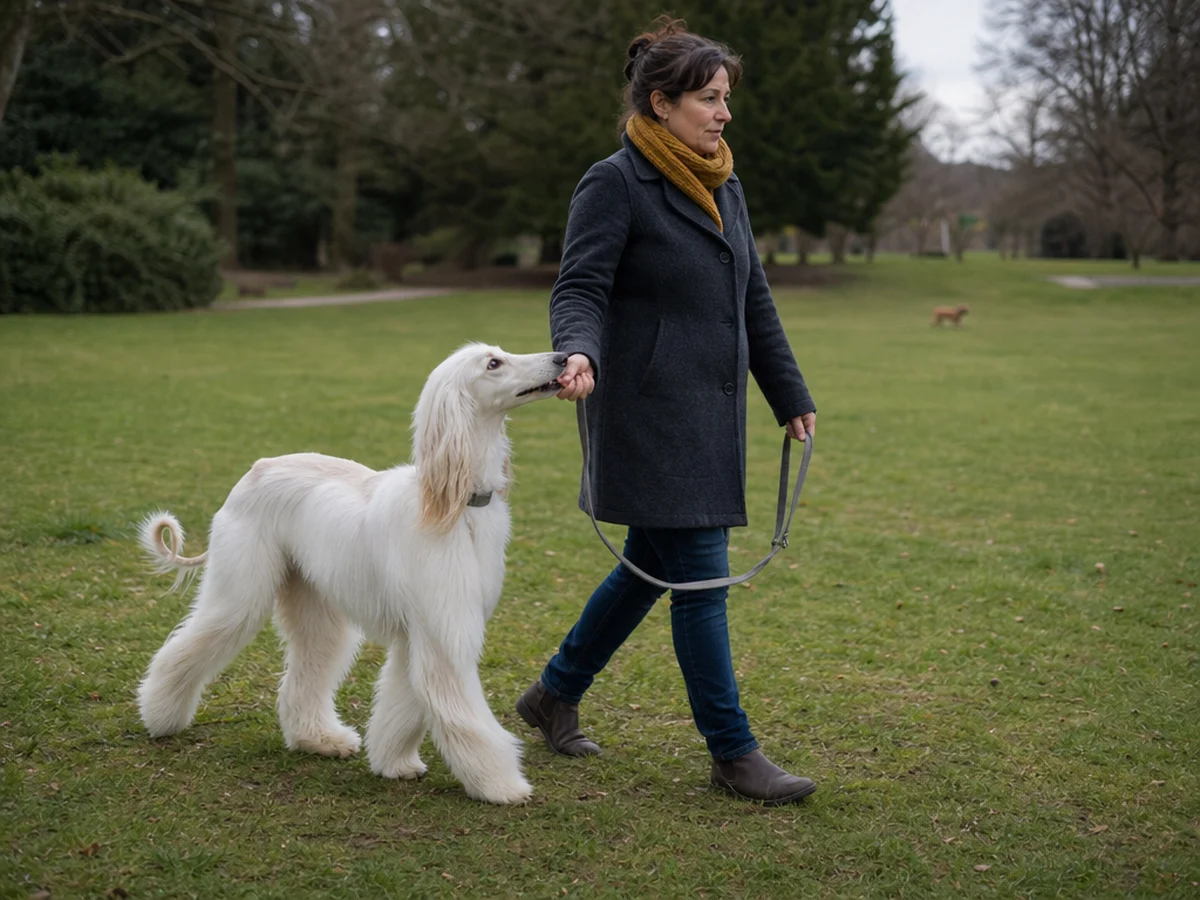
Battersea's reactive-dog guidance uses the word threshold for the distance at which a dog can stay non-reactive. Inside that bubble, the dog begins to react when the trigger enters it. Treat the idea as an observation about one dog on one day, not a number to memorize, because the workable distance shifts with the route, the trigger, the weather, accumulated stress and the space available.
Space is only useful if you can use it, so choose your exits while the route is quiet. You need to know which direction is physically possible, where the footing is secure and how to avoid tightening the leash in a panic.
Look for wide corners, driveways, side streets, open verges with secure footing and parked vehicles standing well away from moving traffic, all of which let you turn or arc away without crossing a road in a hurry or trapping another dog. A narrow path between fences is a poor place to start a learning attempt even when it is familiar, because close passing removes the choices for both dogs.
Rehearse the turn on a quiet stretch with no trigger present, so the movement is familiar and no one is dragged or crowded against a barrier. A familiar exit reduces handling confusion, but it never replaces distance once a real trigger appears.
Safe Footing and Recovery
Plan the physical side as carefully as the training side. Avoid squeezing between parked vehicles, blocking a driver, stepping onto private land or arcing across uneven ground, since a clever route that puts you at risk is not a good route. Planning the exit is management, not a prediction that your Afghan Hound will react.
Once you have regained enough distance, note how long it takes for ordinary walking, sniffing or reward-taking to come back. Do not set a deadline for it. If recovery is slow or incomplete, make the next stretch of route easier before you ask for more.
Route difficulty and the number of sightings are not the same measure. One close surprise with no escape may be harder than several distant sightings across open space, so write down the layout and the choices it allowed.
The useful question after a sighting is whether your Afghan Hound returned to ordinary movement, not how far you traveled. A loop you can repeat with the same exits makes that question easy to answer, because the layout stays the same from one outing to the next.
A General Method for Afghan Hound Leash Encounters
The American Veterinary Society of Animal Behavior explains that training for a fearful dog is often desensitization and counter-conditioning. It describes that approach as very effective but not an instant fix, and says management helps protect the training and keep the dog feeling safe. In practice, that is a reason to choose easier conditions between planned learning attempts.
A learning attempt begins only when your Afghan Hound can notice the trigger without being pushed into a reaction. The aim is not to stay until the dog proves tolerance. It is to pair a manageable observation with a useful outcome, then leave while ordinary movement is still available. Check the exit, the leash and your footing before deciding to stay. Have an ordinary reward ready, and never wave it toward the trigger or use it to pull the dog closer.
One Encounter, in Order
This is a general method for one encounter, not a repetition schedule. It works in this order.
- Move to the planned distance before your Afghan Hound is committed to a close pass.
- Watch for the ability to notice the trigger, move, take an ordinary reward and turn away without being pulled.
- When your dog makes a voluntary choice, such as looking away, softening the body or walking on with you, deliver the reward promptly and place it so it supports the way out.
- Use the exit, then decide whether the walk continues somewhere easier or ends.
Place the reward so it supports the exit instead of drawing your dog back toward the trigger. It should follow the voluntary choice, not cover up an approach your dog cannot manage. If eating slows the departure or adds leash conflict, leave first and talk through the setup with the professional supporting your plan.
One safe observation can be enough for that outing. If the other person or dog changes direction, your Afghan Hound changes posture or stops participating, skip the learning step and leave. Do not circle back toward the same trigger, because reapproaching can turn one manageable observation into a harder encounter.
A practiced turn can support the exit, and it is worth rehearsing. The American College of Veterinary Behaviorists notes that teaching a dog to perform actions on cue usually does not get to the root cause of a behavior problem. Compliance with a cue is not the same as resolving the response, which is why the plan leans on distance and the exit first.
When Afghan Hound Reactivity Needs More Than a Plan
Seek qualified reward-based help when reactions are frequent, worsening, hard to escape or unsafe for the handler, the dog or the public. Keep up regular veterinary visits too, and pause behavior practice when a sudden physical or sensory change could be affecting the walk. We can describe a safe general approach, but we cannot tell you why your dog reacts.
Bring a short record to any appointment. Include the trigger description, the approximate place, the first visible change, the route you took away and the signs that ordinary movement returned. Include routes that stayed manageable alongside the hard encounters, so the conversation focuses on setup and recovery rather than treating the most dramatic event as the only useful information.
Everyone who walks your dog needs the same few things: the exit cue, the reward options that are safe to use and the conditions that end an attempt. They do not need identical technique. If one walker cannot manage a route securely, choose a different route for that person. Practice the shared cue and the route change when no trigger is around, and pass along urgent safety changes right away instead of waiting to compare notes at the end of the week.
Records should support decisions, not turn into a score for the dog. Keep entries brief enough that every walker will really use them.
Afghan Hound Reactivity Questions From Real Routes
- Should a class instructor hear about reactions that happen outside class?
- Yes. Describe the trigger, the route, the distance landmarks, the first visible change and the recovery rather than using only a label. Ask how the class space, entrances and exits will be managed before bringing your dog into that setting.
- Can an Afghan Hound react differently on two familiar routes?
- Yes. Sightlines, available exits, how the trigger moves and earlier encounters can change what a dog can manage. Treat each route as its own setup and keep the easier option available instead of assuming familiarity makes both equally workable.
- Will more greeting practice help a reactive dog?
- Not on a reactive walk. Planned introductions and voluntary contact belong to the groundwork in our Afghan Hound socialization guide. Forcing greetings mid-walk only removes the distance and the choices your dog needs.
- What if the trigger appears and there is no exit?
- Increase distance in whatever direction is physically safe, keep secure handling and end the walk if the space simply is not there. Do not test whether your dog can cope at closer range. Afterward, treat that spot as a place to avoid until the layout offers a way out.
A Reactive Afghan Hound Walk That Goes Well
The next walk comes down to the route you pick. Look for a wide corner, a side street or an open verge where a trigger can pass at a distance, and pack a reward your dog can actually take.
If your Afghan Hound noticed something, took a reward and turned away with you, keep using that stretch. When a sighting stays manageable, reward the voluntary participation and leave while recovery is still possible. If the response climbed, swap in an easier stretch.
 Exercise and jobsIndoor Activities and Brain Games for an Afghan Hound
 Exercise and jobsEasy Tricks to Teach an Afghan Hound
 Training basicsAfghan Hound Temperament: What It Means for Training