 Afghan Hound
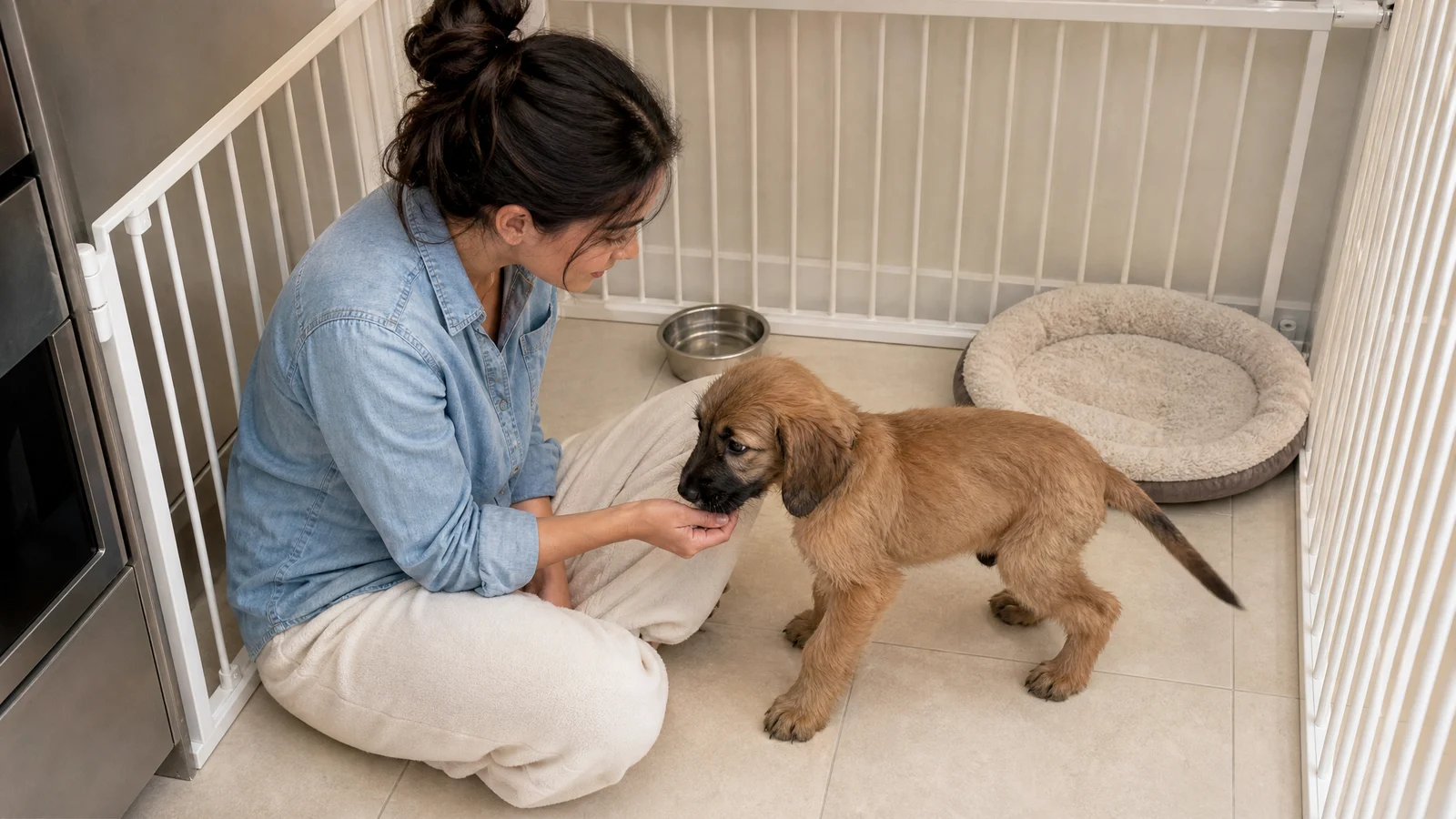
During the first month home, an Afghan Hound puppy needs secure boundaries, gentle exposure and one simple reward-based lesson more than a long list of finished skills. Eight to 12 weeks is a period for learning how the household works, not a deadline for proving what this puppy will become.
Start by controlling access to doors and busy spaces, then notice where the puppy can eat, rest and explore comfortably. Move through new experiences at the puppy's pace, keep the lesson easy enough for voluntary participation and maintain regular veterinary visits. Below, we follow that route from the starting area to one repeatable first lesson for this individual puppy at home.
An Afghan Hound Puppy Needs a Safe Starting Area
Choose a small part of the home where supervision is practical and the puppy can reach water, rest and an appropriate toilet route without crossing the busiest traffic. A gate or closed door can make the boundary obvious. The area should also offer a resting place that people do not crowd when the puppy steps away.
Make a simple map of access before the puppy explores. Mark the outside door, the normal toilet exit, any room that stays closed and the quiet route between rest and water. This is a household plan, not a prediction about the puppy. It prevents people from inventing different boundaries in the middle of an arrival.
The UKC Afghan Hound description calls the breed strong-willed and independent, with reserve around strangers and playfulness with family. Those broad traits can guide respectful expectations, but they cannot predict whether this puppy will investigate, pause or seek contact on a particular day.
Watch the individual in front of you. A puppy who explores one room may hesitate at the next doorway, while a puppy who rests through one visit may be more alert later. Treat each response as information about the current setting. Do not turn it into a fixed label or a breed-wide milestone.
These rules make respectful access practical. Agree on them before freedom expands:
- Name the person who manages an outside door while another person watches the puppy.
- Keep the route to the toilet area clear and use the same approved exit.
- Protect a resting place where visitors and children will not follow the puppy.
- Decide which rooms stay closed until supervision and routines are reliable.
The Door to the Outside
An exterior door is a management point before it is a training test. Check that the puppy is secured before the door opens, and avoid relying on a new cue to prevent an exit. Keep arrivals quiet enough that the person handling the boundary can see where the puppy is and close the door without a scramble.
Put deliveries, greetings and luggage on the people side of the plan. One person can deal with the open doorway while another remains with the puppy behind the prepared boundary. That division avoids asking a new puppy to solve a busy threshold before the household has taught any doorway routine.
Use the same route for toilet trips so the sequence becomes easy to recognize. The detailed Afghan Hound toilet training plan owns schedules and the full house-training method. This page keeps the narrower job of making access predictable and supervised.
Record what happened without interpreting motive. Note the exit used, whether the puppy walked or was carried and whether the route stayed calm enough to repeat. A short factual note helps the next person follow the same arrangement without claiming that one smooth trip proves a finished habit.
A Place to Withdraw
A retreat works only when leaving is allowed. Place a bed, mat or open resting area away from the main walkway, and let the puppy move there without being called back for another greeting. If the puppy repeatedly leaves an interaction, reduce the activity instead of following them into the resting place.
Protect the approach as well as the bed itself. A puppy should not have to pass through reaching hands or a cluster of feet to reach quiet space. Ask people to leave the route open, keep food and toys from blocking it and move conversation elsewhere when the area becomes the center of attention.
Family members can still reward calm choices from a comfortable distance. The point is not to isolate the puppy. It is to make quiet participation and withdrawal equally safe, which gives the household clearer information about when this individual is ready for more.
Expand access only when supervision remains easy and the retreat still functions. Opening another room changes sounds, surfaces and traffic at once, so keep the original safe area available. If the puppy stops resting or starts avoiding the route, restore the smaller arrangement and reassess the change.
What Is General About the 8-to-12-Week Stage?
UC Davis puppy guidance identifies weeks three through fourteen as a critical period for dogs' social development. This is general guidance, not an Afghan Hound timetable or a birthday deadline.
Use that window for careful introductions to household sights, sounds, surfaces and people while preserving choice. New does not have to mean close. A puppy can notice a vacuum from another room or step onto an unfamiliar surface and return to the starting area.
The American Veterinary Medical Association recommends praise, play or treats for positive or neutral engagement in its socialization guidance. It also says an uncomfortable puppy should be free to move away at an individual pace. A calm look from a distance can be useful without requiring a greeting.
Plan an exit before each introduction. Decide where the puppy can retreat, what the person holding the reward will watch and which change will end the experience. A puppy cannot use distance if every route leads back toward what is being introduced.
Change one part of an experience at a time so the response stays readable. A different room, person or sound can make a familiar activity feel new. The broader Afghan Hound socialization guide owns the complete plan for people and other dogs.
There is no sourced Afghan-specific deadline for confidence, settling or a finished cue in this age range. Compare the puppy with their earlier comfort instead of with a breed milestone. If participation becomes harder, restore distance or offer a genuine break.
Keep ordinary care separate from a social checklist. Veterinary visits, sleep, meals, toilet access and uninterrupted rest still shape the day. Quality comes from readable, comfortable participation, not from filling every waking period with novel items.
First-Month Afghan Hound Puppy Questions
The starting area and development guidance cover boundaries, retreat and the pace of exposure. Three smaller transition decisions still need explicit answers because they affect how the household carries the plan from one person or day to the next.
These are not tests the puppy must pass. They help people keep signals consistent, preserve useful background information and avoid turning quiet observation into forced social contact.
The answers stay within the same reward-based approach and fill only gaps left by the body. They do not create another milestone schedule.
- Should everyone use the same marker word with a new Afghan Hound puppy?
- Yes, choose one brief marker that participating household members can deliver consistently. A marker identifies the successful action and predicts a reward, so changing words casually can make the first lesson less clear. Agree on the word and the behavior being marked before practice begins.
- What information should come from the puppy's previous caregiver?
- Ask about familiar food, the rest setup, toilet routine, handling history and responses to ordinary people, surfaces and sounds. Treat that information as a starting observation rather than a guarantee about future behavior. Share relevant care records with the veterinarian and keep regular visits in place.
- Does a quiet puppy need to greet every visitor?
- No, social exposure does not require direct contact with every person. Let the puppy watch from a comfortable distance, reward neutral or positive engagement and preserve a route to the resting area. A visitor can help by ignoring the puppy until the puppy chooses whether to approach.
Record which arrangement helped the puppy remain comfortable rather than scoring each encounter as a success or failure. That note will be more useful for the next setup than a claim that the puppy is naturally outgoing, aloof or finished with social learning.
One First-Month Lesson With Your Puppy
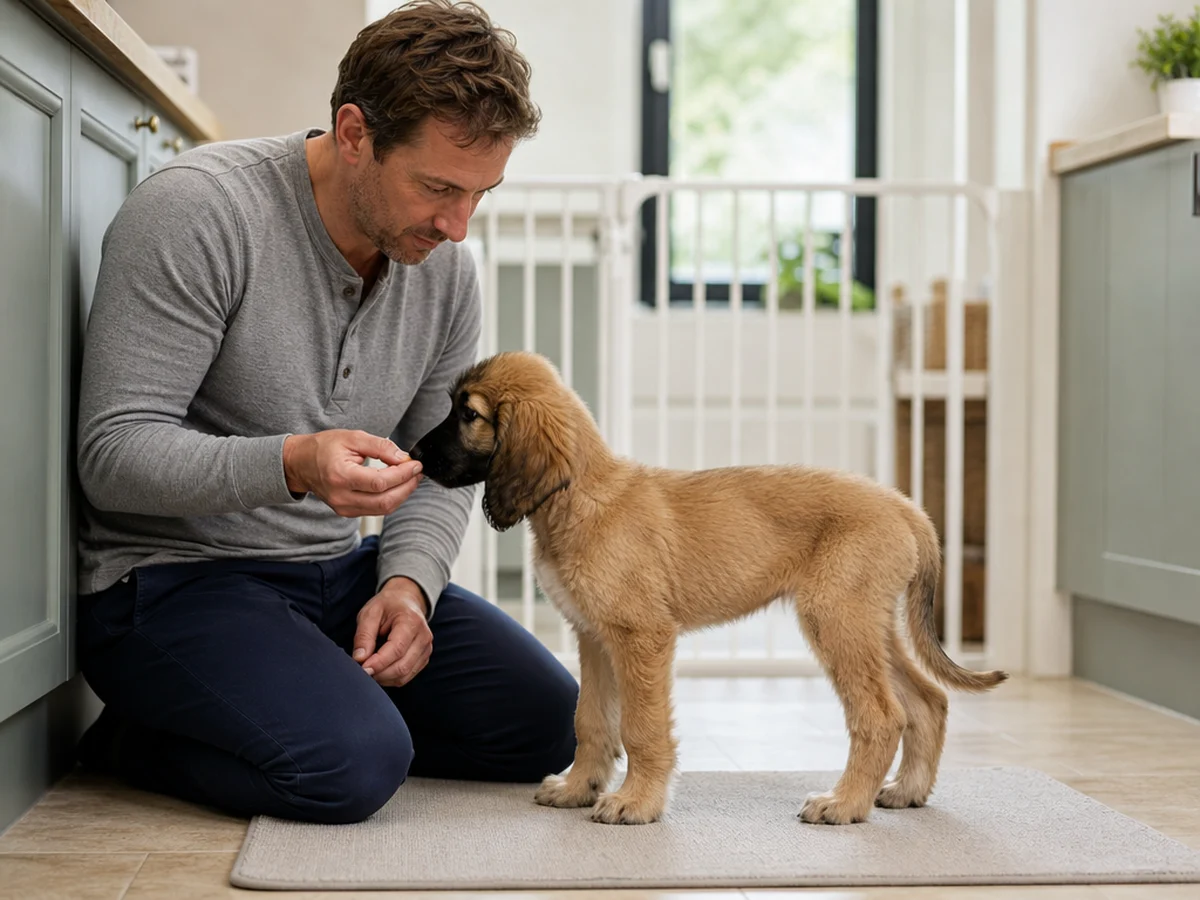
Choose one voluntary action in the starting area, such as looking toward the handler or stepping onto a mat. The goal is to teach the pattern of request, correct choice, marker and reward without turning the exercise into a complete behavior program.
The AVSAB reward-based guidance describes a cue that requests behavior, a clicker or spoken marker that identifies it and a reinforcer that follows. Keep that general method separate from breed assumptions. This puppy's response shows whether the setting and reward are workable.
This is the general first-lesson approach. Each step keeps participation voluntary:
- Prepare an easy area with the reward ready and unnecessary activity removed.
- Wait for attention or invite one simple action without moving into the puppy's space.
- Mark the wanted action at the moment it happens.
- Deliver a valued reward, then allow time to reset or disengage.
- End while participation is comfortable, or simplify if the puppy leaves.
Choose an Easy Moment
Practice when the puppy is awake, able to take a reward and not occupied with eating, toileting or settling to sleep. An easy moment matters more than a fixed duration. If the puppy wanders away, pause instead of repeating the cue.
Keep the first version in one familiar place. A response there shows that the setup made the lesson understandable, not that the skill is finished everywhere. On another day, change only one feature and be ready to make the task easier again.
Carry a Comfortable Afghan Hound Routine Forward
At the end of the first month, keep the boundary, setting and reward that helped this puppy participate comfortably. Note where the puppy could observe without retreating, which household transition remained easy and what made the lesson clear. Those observations guide the next adjustment without turning age into permission for unrestricted access.
Continue supervised exposure, preserve the resting place and manage exterior doors even when early cues look promising. Expand the puppy's world in small, readable changes, and return to the last comfortable version when the response shifts.
The useful outcome is a household that knows how to make learning safe and a puppy who can choose to engage. That foundation carries into later skills while the Afghan Hound remains an individual, not a timetable of expected achievements.
 Exercise and jobsHow to Teach an Afghan Hound to Roll Over
 Training basicsClicker Training an Afghan Hound
 Training basicsAfghan Hound at 1 Year and Up: When Do They Calm Down?