 Afghan Hound
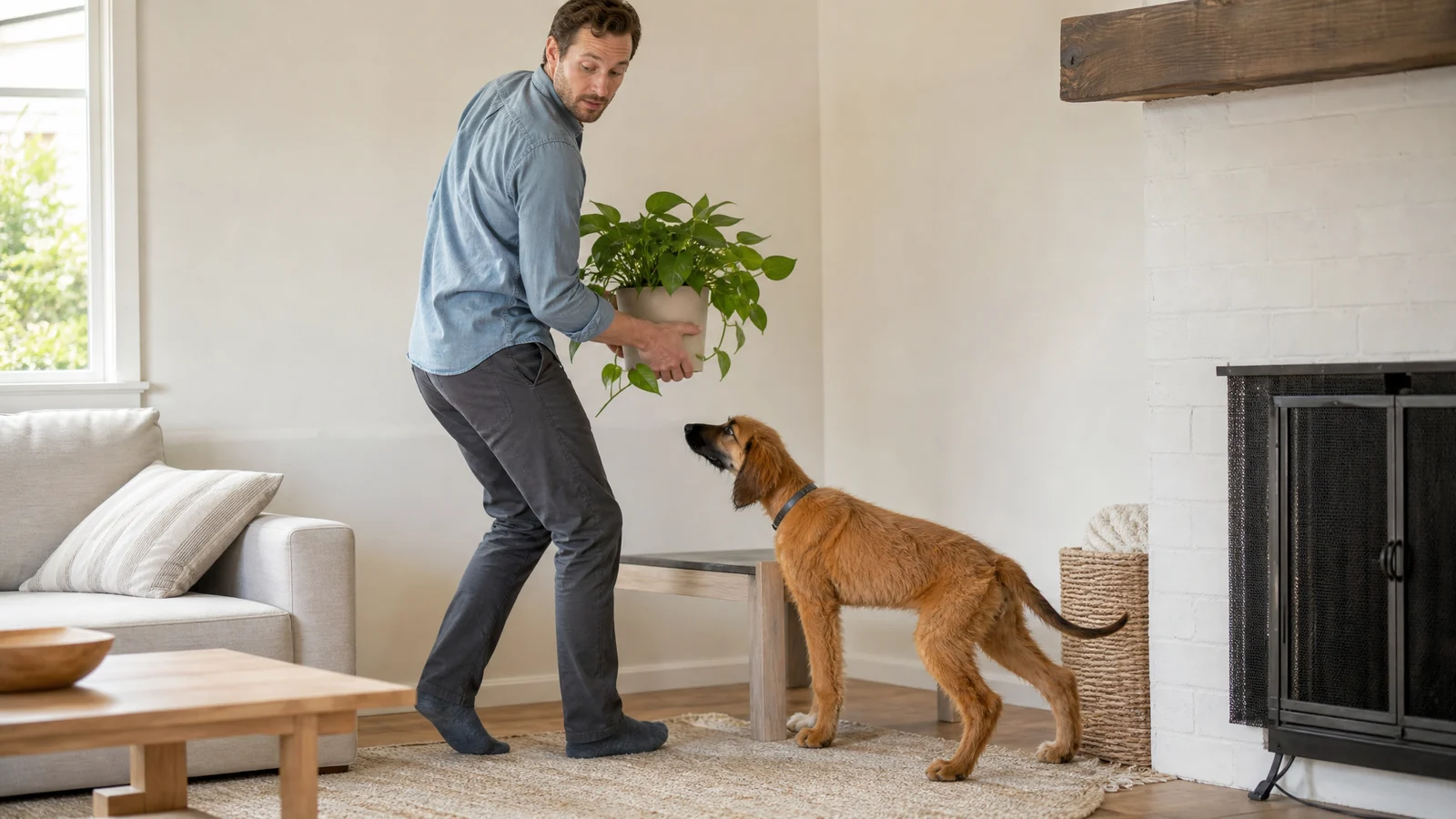
At 4 to 6 months, recheck what your Afghan Hound puppy can reach and how they move before carrying a familiar skill into the changed space. A room that worked earlier may now invite a different path around furniture, access to a higher object or a wider turn. The answer is a fresh safety check, not a prediction about final size.
Begin with the physical learning area rather than a longer cue list. Remove new access problems, preserve secure boundaries and identify one place where the puppy can still orient comfortably. Then decide whether the familiar task belongs in that setting today.
This guide covers floors, turning space, reachable objects, general tooth-development context and one reward-based transfer sequence. It does not set an Afghan-specific growth date or promise that a behavior learned in one room will automatically appear in another.
Recheck the Space Around a Growing Afghan Hound Puppy
Changing reach can alter what the puppy contacts even when the room looks the same to you. Revisit the route from entry to resting area, note where the puppy must turn and remove objects that have become accessible. Keep the check practical and individual. No source in this brief establishes how large an Afghan Hound should be on a particular day in this window.
The American Kennel Club describes Afghan Hounds as independent and dignified. That broad breed context is not an explanation for bumping furniture, taking an object or hesitating on a surface. Our training team would change the setup first, then observe what this puppy can do comfortably.
Floors and Turning Space
Watch the puppy enter, turn and leave without asking for a cue. A clear route should not depend on squeezing past a chair, sliding on a loose mat or stepping over training equipment. Move the obstruction and give the puppy enough room to choose a stable position before inviting any practiced behavior.
Check the route from the puppy's eye level as well as your own. A dangling cord, low shelf corner or narrow gap can become relevant when the puppy approaches from a new angle. The purpose is not to make the room empty. It is to keep the learning area predictable enough that movement does not compete with the task.
Objects Within Reach
Scan table edges, low storage and the floor for items the puppy can now contact. Put unsuitable objects away instead of relying on repeated verbal interruption. If the puppy reaches one, calmly prevent continued access and offer an appropriate alternative. PDSA supports redirection to a safe toy and praise rather than punishment.
Include care equipment in the check. Brushes, cloths and handling supplies should be ready for the person using them, not available as unsupervised chew items. The full cooperative routine belongs in Afghan Hound handling practice, while this stage page owns the decision to revise access around that routine.
After both checks, match the changed access to one immediate response. The table is a planning tool rather than a claim that every puppy will meet the same condition at this age.
| Changed access | Management response | Training decision |
|---|---|---|
| The puppy turns into a narrow furniture gap | Open the route or block the gap | Practice only after movement is comfortable |
| A household object is newly reachable | Remove it and provide a suitable alternative | Do not use the object as a test |
| A familiar cue weakens after the room changes | Restore distance and reduce distractions | Return to the last workable version |
| The puppy withdraws or appears uncomfortable | Pause and preserve an exit to the easy area | Seek appropriate professional advice before adding difficulty |
What the 4-to-6-Month Puppy Stage Does Not Promise
Tooth development provides general context, not an individual clearance date. The Texas A&M School of Veterinary Medicine says adult teeth should generally be in place by 6 to 7 months. The American Kennel Club gives a similar general point around six months. Neither statement creates an Afghan-specific deadline.
Do not use the month alone to decide that chewing, eating or handling should feel normal for this puppy. Continue supervising access and respond to what you observe. If mouth comfort, eating or ordinary behavior changes suddenly, pause training and contact your veterinarian rather than trying to train through discomfort.
We recommend regular veterinary visits throughout this stage. A veterinarian can assess the individual puppy's teeth, mouth and comfort, while the training choice is to stop adding difficulty until a concern has been evaluated.
The learning space also does not need to become harder because the puppy is older. The American Veterinary Medical Association recommends reinforcing positive or calm contact with the surroundings while letting an uneasy puppy step away. Keep that exit available whenever the room or activity changes.
Carry One Puppy Skill Into the Revised Space
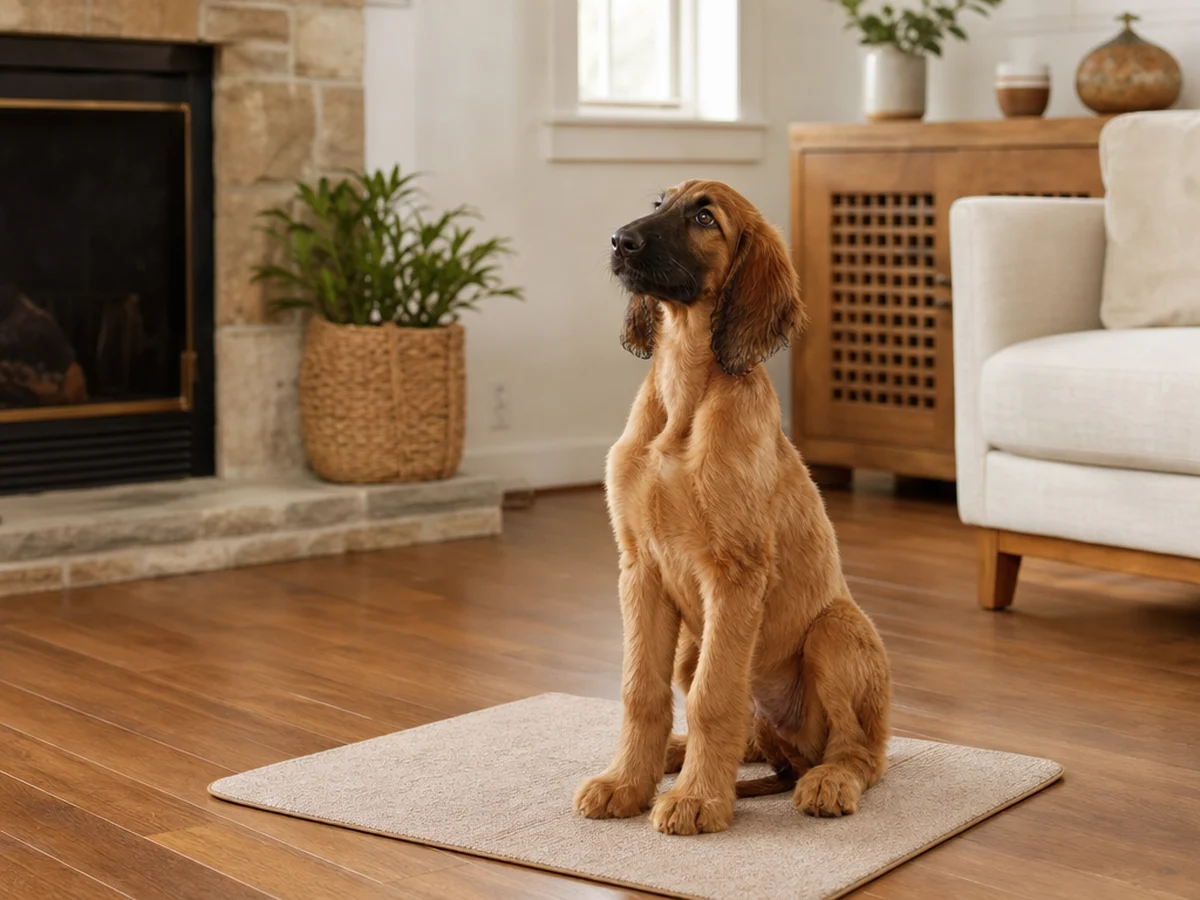
Choose one familiar task only after the space check is complete. A sit, brief orientation or move to a mat can show whether the puppy recognizes the cue under one changed condition, but this page does not replace the full lesson for that skill. Use the following general transfer method to learn what support the new context requires.
- Establish the familiar cue in the easiest available setup.
- Change one condition in the room while leaving the other supports in place.
- Mark the wanted response when the puppy offers it.
- Reward with something the puppy values in that context.
- Simplify by restoring the easier setup if participation changes.
The sequence compares contexts rather than testing obedience. If the response disappears, reduce the environmental change and keep the cue itself familiar. A comfortable withdrawal can also be useful information. The separate Afghan Hound socialization guide owns the broader plan for people, animals and unfamiliar settings.
End after you know which version worked. More repetitions will not fix a route that is too tight, an object that remains available or a setting that prevents the puppy from reorienting. Management and learning belong in the same decision, but they are not interchangeable.
Afghan Hound Puppy Questions About Changing Conditions
The body explains how to revise a space and transfer one skill, but it leaves three practical coordination gaps. These answers keep the household record tied to real contexts instead of turning age into a progress score.
- Can a puppy return to an easier room after practicing elsewhere?
- Yes. Returning to the last comfortable setup can preserve a clear cue and show which environmental change was too large. It is useful adjustment, not a failure or a reason to demand extra repetitions.
- Should household members record different responses to the same cue?
- Yes, note the person, room, nearby activity and reward along with the puppy's response. Compare conditions before deciding that the cue itself changed. The record should help the household simplify consistently, not rank people or blame the puppy.
- Does finishing a puppy class mean the dog is ready for every setting?
- No. A completed class records experience in that class environment, not automatic performance in every room or public place. Introduce a known task in each new context at an easier level and preserve the puppy's ability to withdraw.
Keep the Afghan Hound Puppy’s Comfortable Setup Available
Retain the route, spacing and object access that allowed the puppy to participate comfortably. You can revisit one condition later without dismantling the easy option. A reliable starting setup gives you somewhere to return when a changed room makes the familiar task look unfamiliar.
Record the condition you changed and the version in which the puppy could move, reorient and respond. Carry that information forward rather than accelerating activity because of a birthday. The useful outcome of this stage is a safer space and a clearer next decision, not proof that the puppy has finished growing or generalized every skill.
 BehaviorHow to Fix Afghan Hound Separation Anxiety
 Exercise and jobsHow to Teach an Afghan Hound to Spin
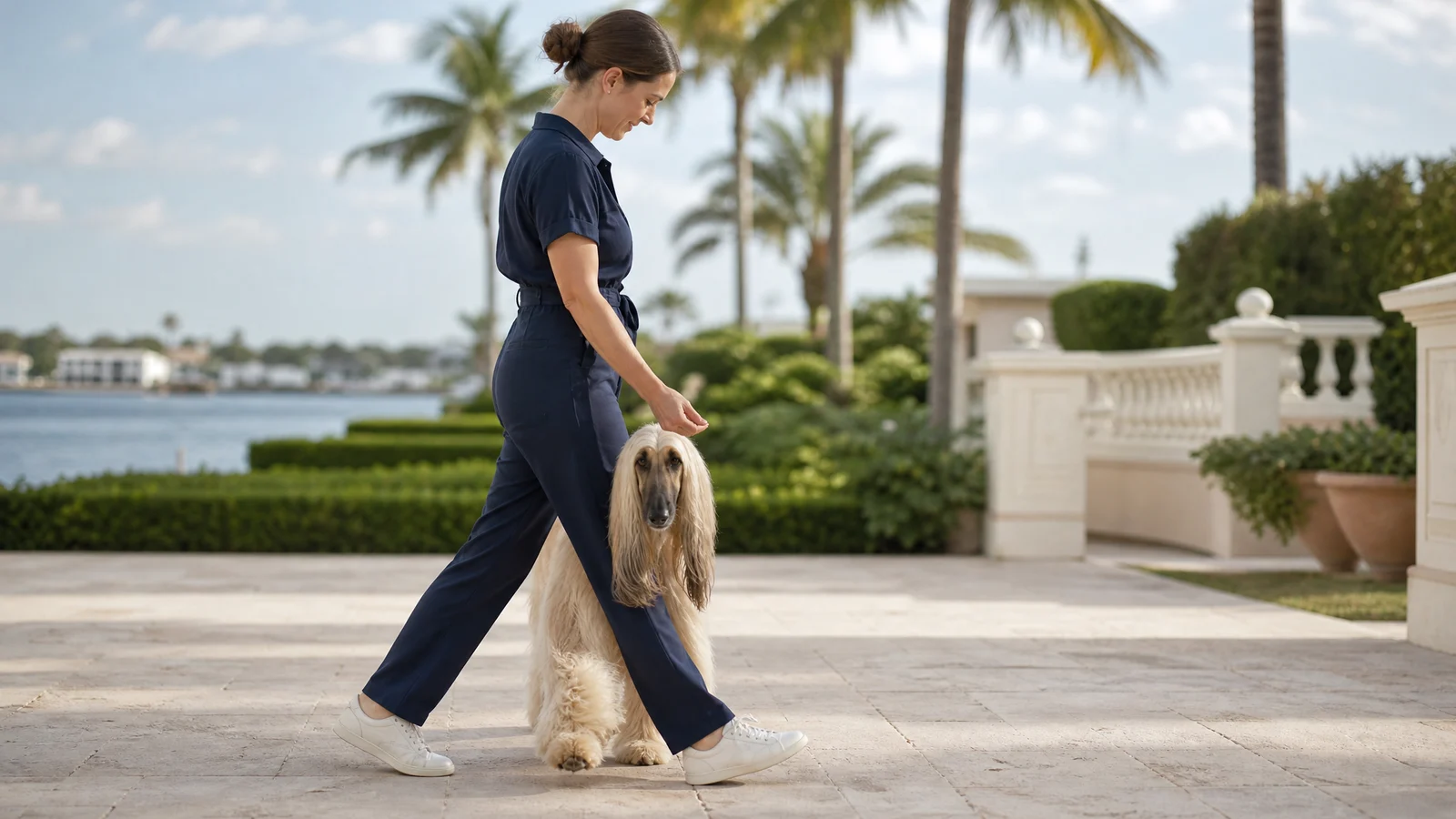 Exercise and jobsHow to Teach an Afghan Hound to Weave Through Your Legs