 Afghan Hound
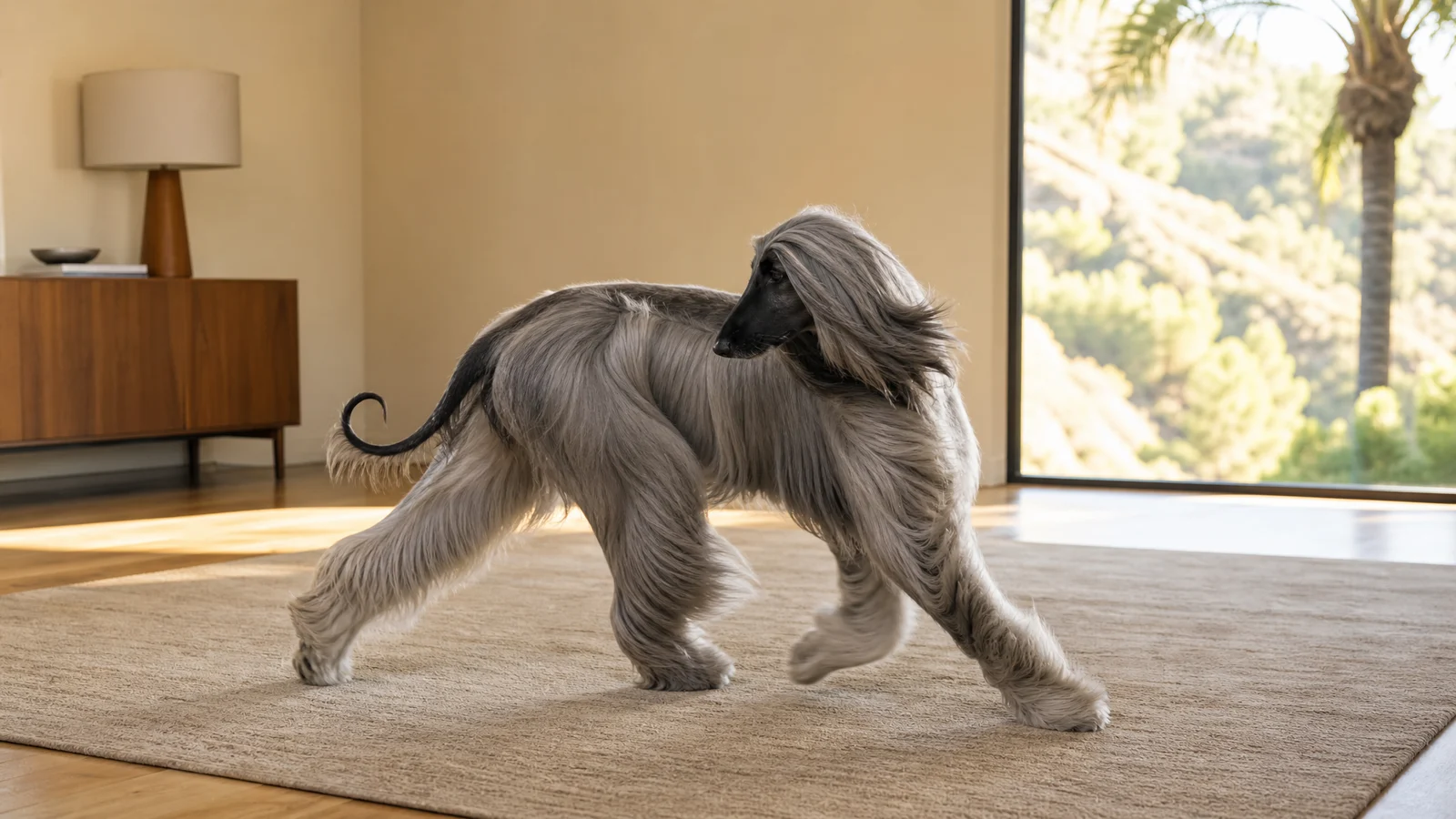
A spin should begin as one small, comfortable turn toward a reward guide. Mark and reward the easiest arc your Afghan Hound can follow without slipping, rushing, crossing the feet awkwardly, or losing interest.
A complete circle is a later possibility, not the price of success. First find where the dog can turn freely, then expand the arc only while their movement stays balanced. This guide separates shaping the path from fading the guide and naming the trick, so speed and repeated circles never become the goal.
Use one direction and one spacious setup at first. A short arc shows whether the target placement suits the dog's body before a larger curve is attempted, and a straight walk away gives every repetition a neutral finish.
Clear Space for an Afghan Hound Turn
Choose a level nonslip surface with enough room for the whole dog to move without brushing furniture, walls, or people. Watch the Afghan walk and change direction normally before presenting a training hand. If ordinary movement already looks different, pause the trick rather than using it as a test.
AKC breed information describes Afghan Hounds as independent and dignified. That broad description does not determine how one dog will respond to a circular movement. We recommend letting this dog's balance, willingness, and easy range set the size of the turn.
Keep the rest of the session physically quiet. A spin can be a brief skill inside a day that also meets the dog's broader needs, but it is not a substitute for suitable Afghan Hound exercise or a reason to encourage fast repetition.
Build One Spin From a Partial Arc
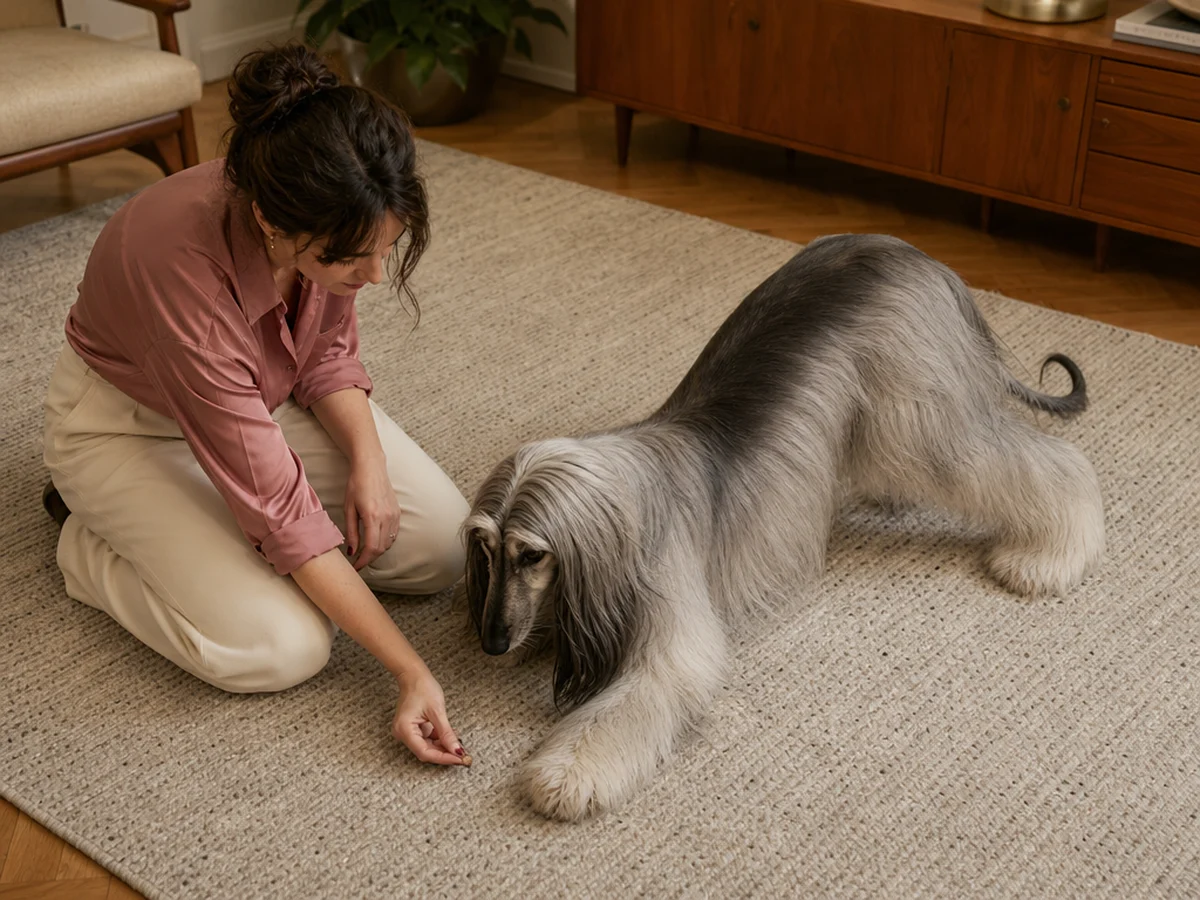
Hold a reward guide close enough for the dog to notice without stretching the neck upward. Move it in a shallow curve beside the shoulder, then stop as soon as the body begins to follow. The general method below develops a single turn from that first comfortable change of direction:
- Present the guide near the dog's nose while leaving room for the head and shoulders to move naturally.
- Draw a short arc to one side and mark the first balanced step that follows the curve.
- Deliver the reward where the partial turn ends, then let the dog straighten and reset.
- Expand the next arc only when the earlier movement stays smooth and the dog chooses to continue.
- Build toward one circle in small sections, while treating any comfortable partial turn as a valid finish.
Do not pull the collar, press the body, or sweep the guide so quickly that the dog scrambles after it. If the back feet stop following cleanly, shorten the curve and reward a smaller response. The trick remains useful even when the finished behavior is less than a full rotation.
Fade the Guide Before Naming the Spin
Battersea spin guidance supports fading the lure before introducing the verbal cue. Begin by changing the full guiding motion into a smaller hand circle while rewarding the same easy path. Do not raise the success standard at the same time.
The AVSAB humane training statement includes shaping and luring among reward-based techniques that connect cues, markers, and reinforcers. For this trick, mark the chosen point in the turn precisely, then place the reward where the dog can finish without another forced bend.
Add the word spin just before the smaller hand signal once the dog follows that signal predictably. The Blue Cross marker guidance supports building a clear association between a marker and something the dog values. Keep the cue separate from the marker so one asks for the movement and the other identifies the successful moment.
Practice the direction already established before deciding whether the opposite turn belongs in the plan. A second direction is a separately shaped path, not something to force by reversing the hand abruptly.
Afghan Hound Spin Questions
The main method covers space, a partial arc, guide fading, and cue timing. Three practical gaps remain about naming directions, keeping the hand signal, and treating spin as evidence for other activities.
Can clockwise and counterclockwise turns use different cues?
Yes, if both directions are comfortable and each is taught separately. Give every direction its own predictable hand path before adding distinct words, and keep a partial arc available as the easier response.
Can the hand signal stay after the word is added?
Yes, if the signal stays small and clear. To fade it, reduce the motion gradually while saying the cue before the hand moves, then reward the balanced turn.
Does learning spin clear a dog for other twisting activities?
No. One voluntary trick does not prove that repeated, fast, or physically demanding rotation is suitable. Evaluate any other activity on its own and stop when movement or willingness changes.
Keep the Next Turn Smaller When Needed
End after one comfortable result and give the dog room to walk away in a straight line. The next session can begin with the last easy partial arc rather than assuming the circle must grow or become faster.
Maintain regular veterinary visits and pause spin practice if balance, gait, turning preference, or willingness changes unexpectedly. A small voluntary turn is a complete training success, and omitting the trick is the right choice when rotation is not comfortable.
Keep the established direction when returning to practice. Treat a reverse turn as a separate future choice, with its own small starting arc and the same comfort checks.
 Exercise and jobsHow to Teach an Afghan Hound to Weave Through Your Legs
 Training basicsHow to Teach an Afghan Hound to Stay
 Puppy trainingAfghan Hound Puppy at 8 to 12 Weeks: The First Month Home