 Afghan Hound

Barking that has already built to full volume is the hardest kind to change, so the work starts earlier: with what the Afghan Hound can see, hear and reach in the minutes before the first sound. Making that part of the day easier does more than any cue shouted over the noise.
Training adds the second half. A dog who has somewhere better to go, and a reason to go there, has less need to stand at the window and keep going. This guide is about quieting an Afghan's barking by changing the setup around the dog, with two habits running underneath: writing down what actually happens, and noticing when barking needs more than training.
Take Away the Barking Rehearsals Before Teaching Anything
Every uninterrupted round of barking at the window or the front door is practice, and practice makes the sequence faster next time. So the first job is to cut down the number of rounds.
Move a favorite bed away from a busy window, put an opaque covering across the lower half of the glass, close the door to the front room during delivery hours or simply add distance from the entry. The aim is not to hide life from the dog. It is to stop dozens of uncontrolled repetitions while one clear response is being taught.
Fit the Change to the Trigger
Match the change to what actually sets the dog off. Visual cover helps only when seeing the event starts the sequence. A sound-only trigger needs a quieter interior spot, steady household noise or a warning that lets the dog move before the knock.
Keep the alternative resting area comfortable and open before any trigger appears, so that going there never feels like a consequence of barking. If the dog chooses the interior area on their own, reward that choice without waiting for a bark.
Daily Needs and Household Habits
Daily needs deserve a look too, without any promise that exercise cures barking. Compare similar days rather than assuming one energetic walk decides the whole evening, and let the log below show what each dog actually needs.
A dog who is tired, sore or overstimulated may not benefit from simply adding more activity, so rely on the log instead of a breed-wide quota. If the dog seems sore or uncomfortable, pause the practice and ask the veterinarian. Consistent human actions help here too, because they make the result of noticing a trigger predictable from one episode to the next, and a predictable household is easier for the dog to read.
Plan how people will respond as well. One person can change the sightline while another calmly guides the dog to the prepared spot. Avoid shouting across the room, crowding the dog or repeating a word that has never been taught in that setting.
Teaching an Afghan Hound a Quieter Job to Do
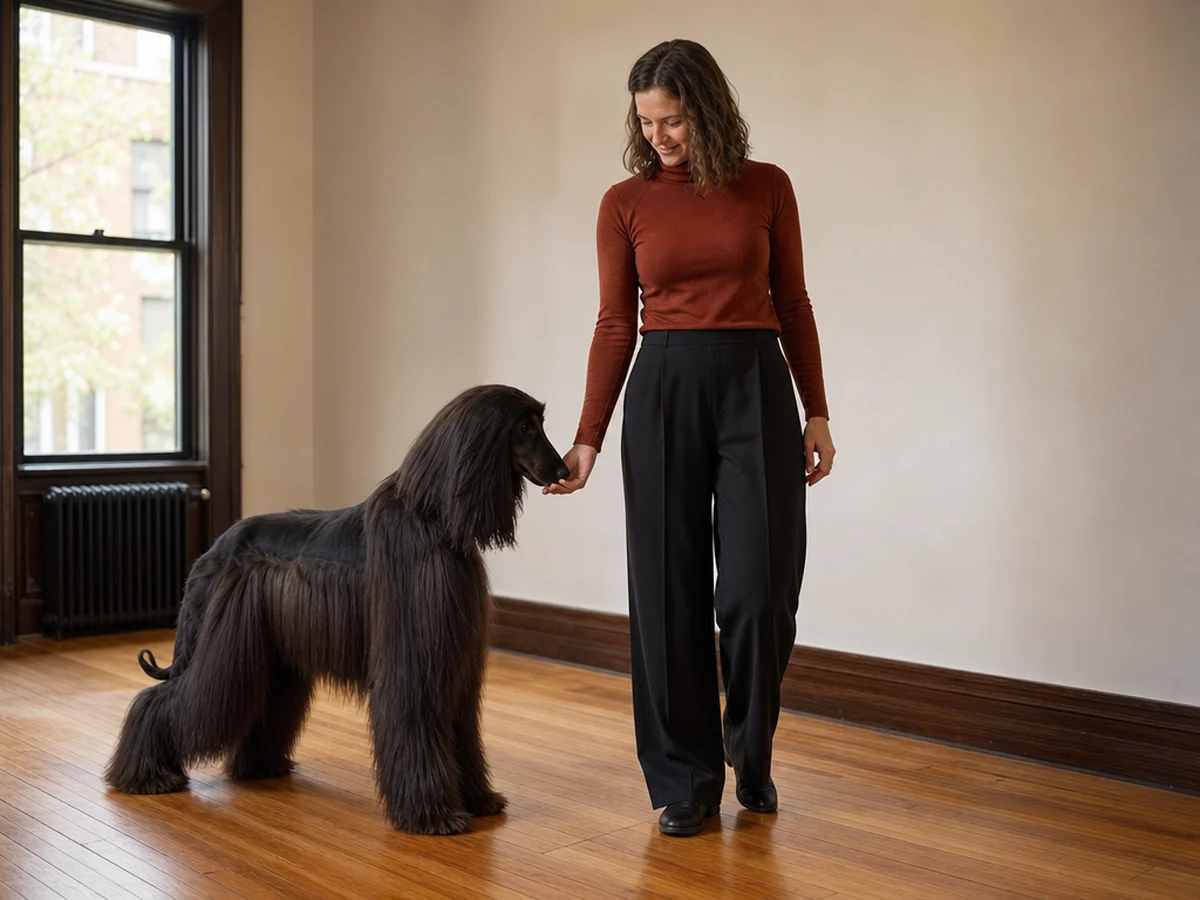
An alternative behavior works when it is available before barking gathers speed. Turning toward the handler, touching a hand or target, or walking to a mat can all serve, provided the dog already performs the action in a quiet room. The behavior is not a punishment for noticing something. It gives the dog a clear route away from staring, rushing forward or staying frozen at the trigger point.
Set up one mild version of a known trigger at a distance where the dog can notice it and still eat, move and respond. Have rewards ready beforehand. This general sequence suits manageable practice and is not a protocol for severe fear, aggression or distress when left alone.
- Lower the difficulty. Increase distance, reduce movement, shorten the view or place a barrier until the dog can observe without escalating.
- Invite one easy behavior. Use the established signal for turning toward you, touching a target or going to the resting place. Say it once and keep the route clear.
- Mark the completed choice. Mark when the dog disengages from the trigger and finishes the alternative, not while the dog is still fixed on the event.
- Deliver the reward away from the trigger. Place it where the dog can stay oriented toward the easier area rather than rushing back to the window or door.
- Allow recovery and finish. Give time to sniff, rest or resume an ordinary activity, and end after a clear repetition instead of raising difficulty mid-session.
Measuring Progress by Recovery
Recovery is also how you know whether practice is paying off. Useful changes include turning away sooner, taking the prepared route with fewer prompts and returning to ordinary activity more readily after the event. One bark does not erase that progress, and silence by itself does not show the dog was comfortable.
Raising the Difficulty Slowly
Choose a reward the dog values enough to leave the window for, and keep it within reach so delivery is prompt. A reward that arrives late, after the dog has already turned back to the trigger, teaches the wrong sequence.
Advance one feature at a time. A slightly closer person, a longer view and a different room are three separate changes, and combining them makes the result impossible to read. When barking starts sooner or the dog stops accepting the reward, go back to the version where recovery was easy. Once the response holds in two easy versions, make the next one only slightly more realistic.
A recording of a doorbell or a voice can help show whether a particular sound contributes, played at a volume the dog can notice comfortably. It will not reproduce scent, movement, closeness or the household's reaction at the door, so treat it as a partial test and stop if recovery slows.
Do not turn the alternative into a command shouted over repeated barking. If the dog cannot respond, the practice version was too hard, so change the distance, the visibility or the timing and wait for one that is genuinely easier. A cue that only works in quiet rooms is still a useful start, and the next step is simply a slightly busier room.
Keep an Afghan Hound Barking Log That Shows a Pattern
One dramatic episode tells you little. Several short entries, written in the same format, tell you a great deal. The ASPCA barking guide explains that barking serves many functions, so the cause and the dog's motivation need to be identified before a response is chosen. A log gives you the material for that, as long as it holds observations rather than guesses.
For each entry, note the room, what or who appeared, how far away it was, whether the dog could move and what happened right after the sound. Add how long the dog took to resume ordinary activity. A cart across the street is a different event from a person on the porch, and one fenced dog is different from several running nearby. Also mark whether the trigger was seen, heard or both, since closing a curtain cannot change a sound-only event.
Begin each entry a little before the bark. Was the dog resting, watching through a window, waiting near a door, playing, eating or moving between rooms? Record the first change you could see, such as standing up, staring, moving closer, pausing play or turning toward a noise, without claiming to know what the dog felt. If the trigger stayed in view, note whether the dog had a clear way out of the viewing area and whether that route was used.
What Happened Next
The consequence column matters most and gets skipped most. Did someone call repeatedly, walk to the window, open a door, offer food or start a conversation with the visitor? That response may be keeping the sequence going even when the person meant to end it. Write it down without blaming anyone.
Finish every entry with recovery. Note when the dog could look away, walk to another area, sniff, take a treat, rest or go back to the earlier activity. That is something you can observe, and it is more informative than writing that the dog finally calmed down, because it keeps the conditions that made the change possible.
After a handful of entries, read them side by side. Look for the room that keeps appearing, the channel that keeps starting the sequence and the response that keeps following it. A pattern that repeats across entries is a setup you can change, and it tells you which trigger to work on first.
Leave the Motives Out
Leave the dog's motives out of the entries. Words like stubborn, protective or jealous describe a guess, and a guess is hard to change while a setup is easy to change. The United Kennel Club standard describes an independent thinker who may be aloof with strangers and playful with family, which supports offering choice and distance. It cannot tell you why this dog barked in this room today.
Barking That Calls for More Than a Quiet Cue
Some barking does not belong in a quiet-signal lesson at all. The table sorts common situations by what you observe, so a simple training exercise does not stand in for a veterinary visit or a qualified behavior plan.
| What You Observe | What to Do Next | Why It Leaves This Lesson |
|---|---|---|
| Barking begins mainly after the household leaves, with escape attempts, destruction or inability to settle | Record the departure sequence and use Afghan Hound crate training only for comfortable resting guidance, then seek help for possible absence distress | Confinement and a quiet cue do not resolve separation-related distress |
| The barking is new, sharply increased or paired with a change in movement, sleep, appetite or awareness | Pause training and contact the veterinarian with the dated log, and keep regular veterinary checkups going either way | A sudden change deserves assessment rather than an assumption about motivation |
| A visitor, dog or passing person can be watched at a workable distance and the dog recovers afterward | Reduce access to repeated triggers and teach the alternative sequence above | The setup can be made manageable without forcing a close encounter |
| The dog cannot disengage, lunging or contact is possible, or the household cannot create distance | Use physical separation and consult a qualified reward-based professional | Safety management comes before another practice repetition |
Why the Log Stays in Use
The American College of Veterinary Behaviorists notes that obedience training teaches actions on cue but usually does not reach the root cause of a behavior problem. That is the reason the log stays in use even while the exercises go well, and the reason the first, second and fourth rows of the table send you elsewhere.
Unfamiliar people are a separate topic. Forced greetings do not belong in barking practice, and gradual exposure to people and dogs is covered in our Afghan Hound socialization guide. Here the focus stays on trigger distance, a rewarded alternative and recovery.
Barking Help That Includes the Whole Household
While the alternative behavior is being established, everyone in the home should use the same word or hand signal and reward the same completed action. People can divide jobs, with one changing the sightline and another guiding the dog, but competing signals make an episode harder to read and the response slower to learn.
Quiet earns its own pay as well. Battersea Dogs & Cats Home recommends giving valued attention when a dog is naturally quiet and calm during the day, so barking is not the dependable way to get it. Drop a treat beside the resting dog, or sit down for a minute when nothing is happening.
When the log is open in front of you, choose the single trigger that appears most often and make only that one easier first. A tidy setup for the doorbell, the front window or the neighbor's yard will teach more than a general effort across all three, and the next entries will show whether the change was the right one.
 Training basicsAre Afghan Hounds Good With Kids?
 BehaviorAfghan Hound Leash Reactivity: What Helps
 Exercise and jobsIndoor Activities and Brain Games for an Afghan Hound