 Afghan Hound
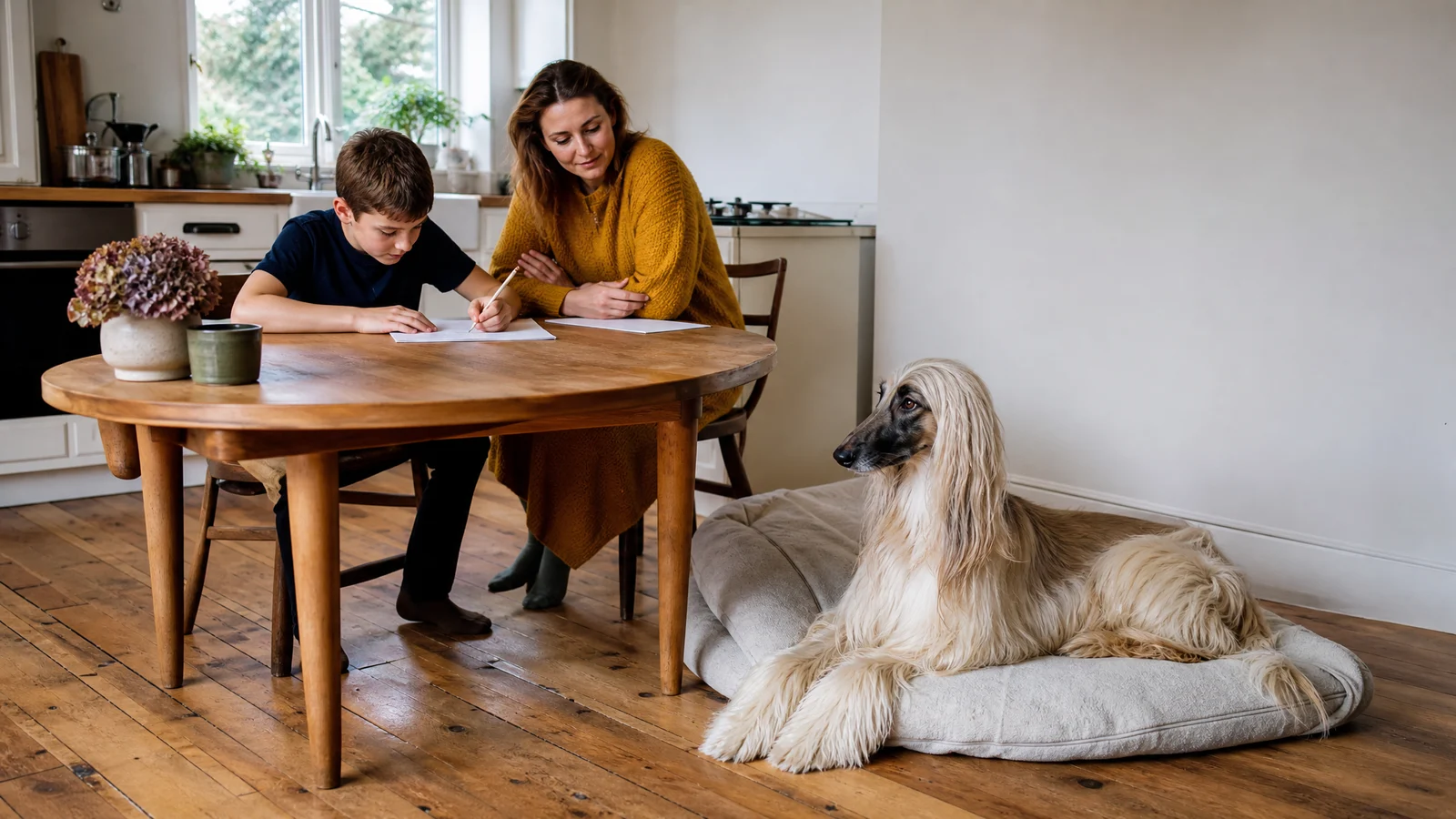
Think of the busiest stretch of your evening: a child home from school, dinner on the stove, a delivery at the door. Whether an Afghan Hound and a child are safely apart or uncomfortably close in that stretch comes down to which adult is watching, and what the room does when that adult looks away.
Nothing about the breed settles that in advance, and we would not trust a description that claimed to. Below, you'll find a plan an adult can run on an ordinary weekday, along with the points where an Afghan Hound's own behavior should change it. It is written for the adults, because the adults carry the responsibility. Children join the plan only in small, supervised ways, and no adult needs a child's help to keep it working.
Plan the Household Around Adult Attention
Active supervision is specific. One named adult is close enough to see both the child and the Afghan Hound, notices a change in either and ends contact before it builds. Cooking, answering a call, settling a sibling or stepping out of the room all pull that attention away, and when it goes, the contact stops. Every other part of the plan exists to make that one rule easy to follow.
Make it easy by deciding ahead what happens at the predictable pressure points: arrivals, mealtimes, the doorbell, noisy games and the bedtime scramble. For each one, settle which adult is responsible and which gate or door closes. A plan that depends on remembering several steps in a hectic moment loses to a plan the room supports, so put the gate where a hand can reach it.
Separation is management, not a verdict on either one. A closed door, a gate or another secure boundary keeps a muddled moment from becoming an emergency, and nobody is being disciplined by it. A child should never be asked to hold the dog, take something from near them or lead them away from trouble. The adult changes access. If a household cannot keep separation up reliably, contact should not happen in that setting.
Handing Over the Watching
When responsibility changes hands, say so aloud. The adult who is leaving states that the child and dog are apart, and the adult taking over confirms before access reopens. Walking into the room or catching someone's eye does not transfer the job. A second adult who happens to be in the room is not automatically a second pair of watching eyes.
The supervising adult also needs to stay free to move. Sitting behind furniture, holding a baby or managing a hot pan makes a quick separation hard. Arrange the room so that the adult can step between the two routes without cornering the Afghan or pulling a child across the dog's path.
What Afghan Hound Reserve Does and Does Not Tell Us
According to the United Kennel Club standard, the Afghan Hound is a strong-willed, independent thinker who is dignified and aloof with strangers, and with family the breed can be exuberant and playful. Those are descriptions of a breed, written about the type as a whole.
They do not describe the individual dog in your home or a particular child. Reserve with strangers does not tell you how a dog will respond to a visiting child, and playfulness with family does not mean a child's rougher games are welcome. We would not treat either trait as a warning label or as a green light. What counts is what this dog does with this child while an adult watches closely.
Wider exposure to unfamiliar people and children is its own project, and our Afghan Hound socialization guide takes it on. Here we stay with daily life at home, where the question is less about meeting people and more about how an adult arranges the day so that contact is never forced on anyone.
That is also why a child should never be the one who decides whether the dog is fine. Reading a quiet dog's mood is an adult skill. When behavior is uncertain, the adult treats the uncertainty as a reason to separate until the picture is clear, rather than asking a child to test it.
Rest, Food and Doorways Stay Child-Free
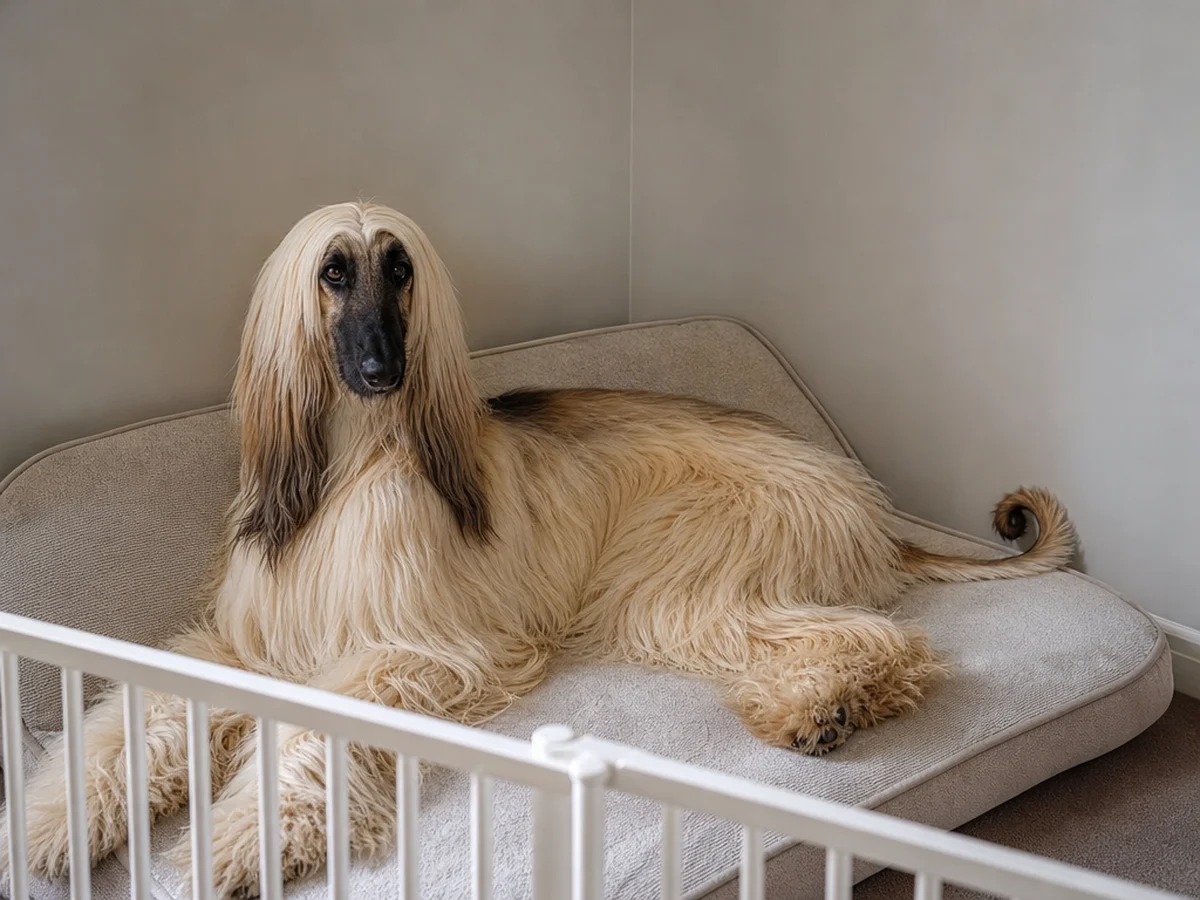
Give the Afghan Hound at least one place that children never enter. A bed, a quiet room or a screened corner works as long as it stays available through play, meals, visitors and homework hours, and the dog can reach it without crossing a child's activity.
Stillness is not consent. A dog lying on that bed may be resting, watching, unsure or unable to leave, and from the outside those look alike. Children do not climb in, hug the dog, handle feet or coat, or carry toys over to them there. If a child needs something from that area, an adult fetches it.
Meals and long-lasting chews belong behind a boundary the adult controls, away from anywhere a child can walk, crawl or reach. Dropped snacks and toys go back through an adult too. Sending a child toward the dog to retrieve something turns an ordinary tidy-up into a risk nobody planned for.
Doorways and Changing Households
Doorways matter as much as beds. A child who rushes into a shared room can cut off the route the dog would use to leave. Pause the child at the threshold, check where the Afghan Hound is, and open a different path if that route is blocked. Explain the rule to every caregiver and visitor before a child enters, so a resting dog never has to defend the space by moving repeatedly or showing a stronger response.
Review all of this when the household changes. A crawling baby, a visiting child or a newly mobile dog can make a boundary that worked last month useless this month, so the plan should follow who and what can reach whom today.
Afghan Hound Signals That Mean the Moment Is Over
Watch the dog before, during and after any time near a child, not only at the instant something goes wrong. Turning the head away, moving behind an adult, leaving the room or going still can all matter in context, and the adult's job is to give distance at the first sign rather than waiting for a dramatic one.
The Battersea Dogs & Cats Home body-language guide names tension around the face, a tail held down between the legs and a lifted front paw as ways a dog asks for a situation to stop. One signal does not explain everything, but it is plenty of reason to make space. Match what you see to what you do:
- When the dog turns away, leaves or heads for their rest space, open the route and keep the child from following or calling them back.
- When the dog goes still or their face tightens, end proximity and put a physical boundary back before anything else happens.
- When the dog guards a space, food or an object, move the child away and arrange help from a qualified behavior professional before another attempt.
- When the adult's attention is needed elsewhere, separate first and deal with the other task second.
The PDSA advises letting a dog walk away from a situation, because blocking their escape can send them further up the ladder of signals. In a house with children, that means the child does not follow, and nobody coaxes the dog back with food to finish the interaction.
When Qualified Help Comes First
If an Afghan Hound freezes, growls, snaps or guards access around a child, contact stops and a qualified behavior professional who works with rewards comes in before any further trial. Do not ask the child to recreate the moment for an assessment. Keep the separation in place and describe the context accurately instead: distance, noise, movement, the available exit and what happened just before the dog withdrew.
Regular veterinary visits belong in the plan as well. If an Afghan Hound who was comfortable with household noise or touch suddenly seems less so, mention it to the veterinarian rather than guessing at the reason, and keep children out of the experiment while you find out.
Afghan Hounds With Visiting Kids, Older Children and Babies
Three situations strain even a good routine, because the people, the noise level or the adult's attention all change at once. None of them has a universal child-age cutoff behind it, so each is handled by the same method: separation first, observation second, and contact only when the adult is satisfied on both counts.
When a Visiting Child Arrives
Knowing one child does not prepare an Afghan Hound for another. A visitor moves, talks and approaches differently, and the household's own rhythm usually shifts as well. Begin with the dog and the visitor apart, explain the rules to the visiting adult and allow observation from across the room.
A short visit with separation is better than a long one with improvised contact under social pressure. Agree beforehand who will tell the visiting family where the dog can rest undisturbed and how everyone will end proximity without a discussion in the moment.
Visits go better when the child's movement is planned before the dog joins the room. Choose where active games happen, keep one walkway clear and decide how the adult will pause contact if excitement rises. Changing the environment early is easier than expecting either a child or a dog to make a good decision in the middle of motion.
When an Older Child Wants to Help
An older child can be a real help, within limits. They can remain seated while an adult rewards the dog for choosing distance, or note down what happened while the adult handles every decision that involves the dog. They should not be asked to demonstrate cues, repeat commands or reach toward the dog to see how it goes.
Age alone does not give a child the judgment or the authority to manage an uncertain moment. The adult keeps the safety plan and the handling, however capable the child seems, and steps in whenever the dog's behavior is hard to read.
When a Baby Joins the Household
A new baby brings unfamiliar sounds, equipment, floor access and divided adult attention all together. Build the protected space for the dog and the adult-controlled separation before direct proximity begins, then revise the plan as the baby becomes mobile.
The ASPCA says that if a dog shows aggression around a baby in any situation, or if you think they might, you should keep them away from the baby at all times and contact an animal behavior expert immediately. Follow that without waiting to see how the next encounter goes.
What Children Can Do Alongside an Afghan Hound
Children have a real place in this plan, and it is quieter than most expect. Watching from a chosen distance is a complete activity. A child can read, draw or talk with an adult while the dog rests elsewhere in the room by choice, and nobody needs to approach anybody. That counts as time together, not as time wasted. Giving a child a calm, defined role also lets them feel included without making them responsible for managing the dog, which is never a child's job.
Touch comes only when the adult has judged the setting and the dog can leave at any point. Keep it brief and stop before the child becomes more animated. The dog does not have to tolerate leaning, climbing, grabbing at the coat, face-to-face contact or being followed after they move away.
Adults decide, children enjoy the calm version first, and the dog's choice to stay or go stays real throughout. That is a household an Afghan Hound can live in comfortably, whatever their breed description says.
 BehaviorAfghan Hound Leash Reactivity: What Helps
 Exercise and jobsIndoor Activities and Brain Games for an Afghan Hound
 Exercise and jobsEasy Tricks to Teach an Afghan Hound