 Afghan Hound
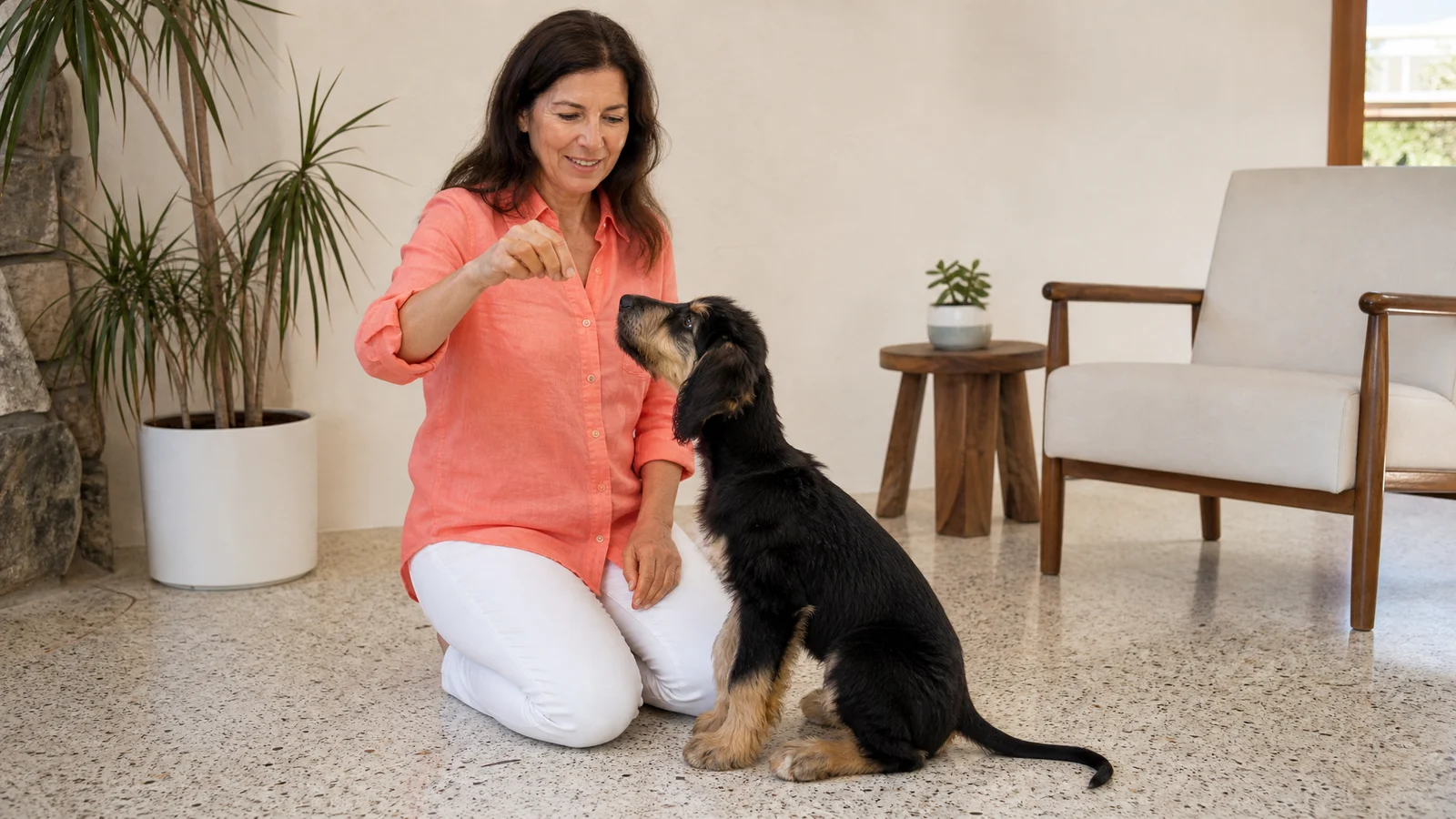
A new Afghan Hound puppy arrives with a household full of questions, and most of them feel urgent at once. Where do they sleep, when do they go out, who may hand out treats, and should a class start this week? Answering all of it with training turns every day into a test.
Much of the early work is not training at all. It is arranging space, agreeing on rules among the people at home and picking a single behavior worth rewarding. You'll see how to tell those jobs apart, and which questions belong to the longer guides on toileting, crates, socialization and biting rather than to this page.
The aim is a workable first stretch at home. One clear next step beats a long list of skills to finish by a certain age.
Afghan Hound Puppy Management Comes Before Lessons
Management changes what the puppy can reach or rehearse. Training changes what happens after a behavior and helps the puppy learn which choice works. Both serve the same household goal, but a gate does not teach a cue, and a cue does not make an unsafe room ready for unsupervised access.
Settle the house rules before the puppy meets several versions of them. Decide which furniture, rooms and doors are open, then make sure every caregiver can hold the same boundary. A puppy has little chance to learn where they are welcome when the answer changes with whoever is on duty.
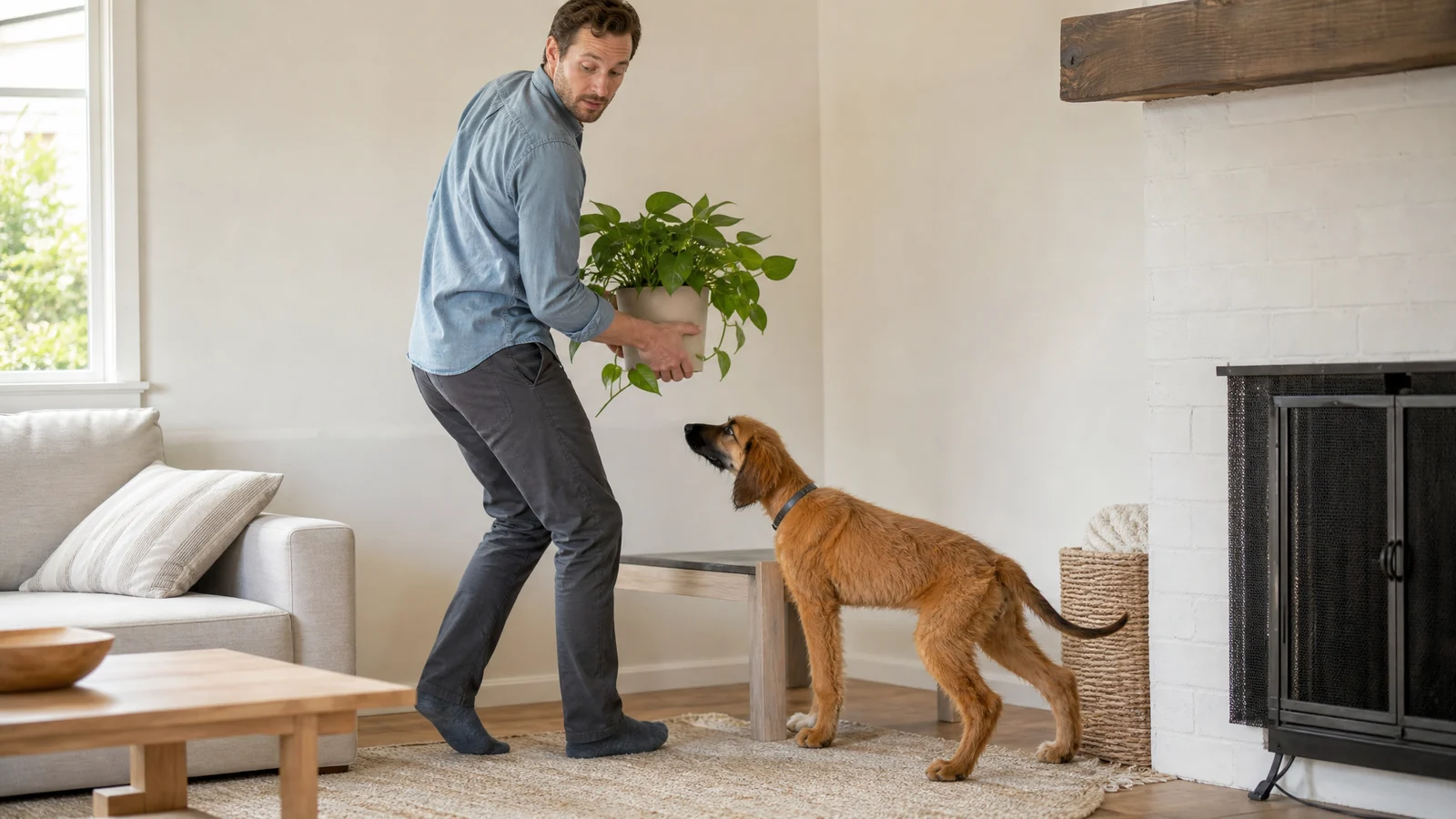
Prepare a resting place, closed storage, safe walking routes and a way to separate the puppy from hazards before any of them is needed. Put everyday supplies where a caregiver can reach them without leaving a door open.
Then watch the setup during real routines. A boundary that holds while one adult is home may fail during meals, deliveries or a change of caregiver. When supervision gets difficult, change the room, the gate or the sequence instead of waiting for the puppy to make an unsafe choice.
Management should leave water, rest, movement and necessary care fully available. It should never depend on startling the puppy or making a mistake unpleasant. The goal is to stop the wrong habit from being rehearsed while the household builds easier chances to learn the right one.
Checking the Setup as Routines Change
Review the fit as the puppy grows. A path around furniture, the reach of a countertop or the room needed to turn comfortably can change before the routine does. Let observation, not a calendar, decide when the setup needs more space or a different boundary.
Rehearse a handoff before it matters. One caregiver secures the puppy while another opens the route, then both confirm the boundary before anyone moves. A sequence like that protects the puppy even when a visitor or household task changes who is supervising.
Making Afghan Hound Puppy Lessons Worth Joining
The American Kennel Club Afghan Hound profile calls the breed independent, dignified and aloof in general, but affectionate and extremely loyal to the people they have bonded with. That is a reason to plan for choice and clear value. It does not predict how one puppy will respond, and it is no excuse to skip patient teaching.
Begin where the puppy can notice you and still move away. Offer a suitable reward for the chosen behavior, leave the pathway clear and stop while attention is still good. Voluntary participation tells you more than holding the puppy in place until a task is finished.
Pick a reward the puppy actually wants, and never withhold basic care to create motivation. In a quiet room a small treat may be plenty, while on a busier path play, sniffing or release to a favorite activity might be worth more.
Short, easy repetitions leave room to finish on a success. If the puppy walks away mid-lesson, end the session there and try again later in a quieter spot or with an easier step. A lesson that ends by the puppy's choice is far easier to start again than one that ends in a struggle.
Pairing a Marker With a Reward
Choose one behavior that can happen in the prepared setting. You might reward orienting to a name, entering the resting area, pausing while a door opens or standing comfortably for a moment of handling. Name the behavior before the session so everyone recognizes the same useful choice.
Blue Cross explains marker training as linking a distinct sound to something the puppy values. Make the sound at the instant of success, deliver the earned reward and release the puppy before asking for anything else. The sound should clarify success, not fade into background noise.
Practice the known response in more than one easy setting. AKC guidance on generalizing notes that learning is context-specific and that reward preferences vary from dog to dog. A puppy who responds in the kitchen may need a simpler version once the room, the person or the activity around them changes.
Write down the setting along with the outcome. If a response disappears, reduce one difficulty such as distance, distraction or duration. Repeating the signal more loudly while every hard condition stays in place only adds noise.
Handling and New Experiences Need an Exit
Handling deserves the same choice. ASPCA grooming guidance points out that some dogs dislike having their feet touched and suggests getting a dog used to it before clipping nails, ideally starting in puppyhood. Touch briefly, reward a comfortable response and stop if the puppy withdraws or tenses, so care never becomes restraint practice.
New people, animals and places call for an exit too. The American Veterinary Medical Association advises rewarding positive or neutral engagement with praise, play and treats, letting an uncomfortable puppy withdraw and moving at a pace that suits that individual. Watching from a distance counts as participation, and no person or animal needs to be approached.
A useful lesson ends with the puppy still able to eat, move and return to ordinary activity. If recovery is slow, simplify the environment or stop for rest and care. A longer session is not automatically more learning.
We recommend comparing participation across similar settings instead of judging the puppy by one hard attempt. Note whether the puppy approached, took the reward, moved away freely and settled afterward. Those observations show which condition to simplify, without turning independence into a label or demanding a fixed number of repetitions.
Agreeing on Puppy Signals Across the Household
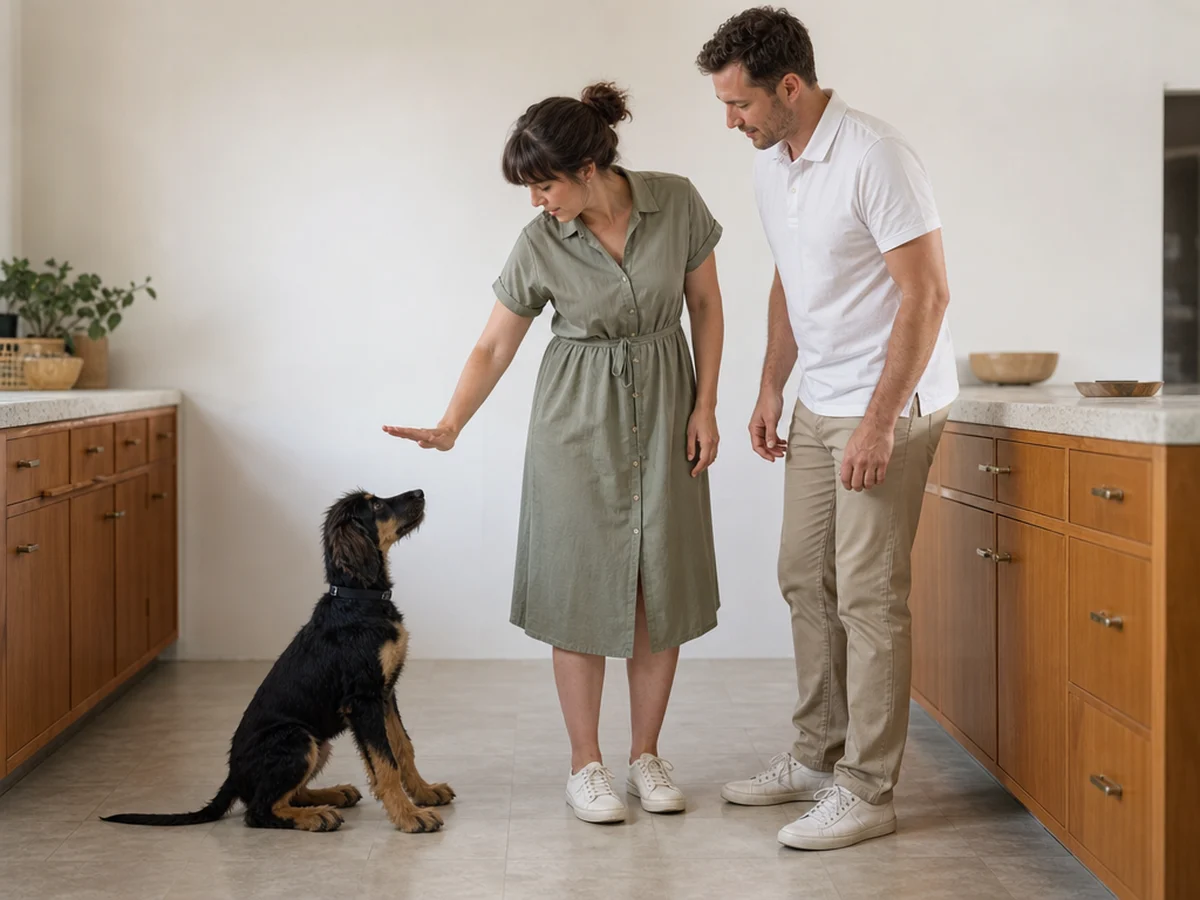
Consistency means the same signal predicts the same job. It does not require every caregiver to sound identical or carry the same treats. What matters is that the meanings, the behavior that earns the marker and the release that ends an exercise are shared.
Name use deserves a note of its own. A name that is only called when something unwelcome is about to happen soon predicts exactly that. Call it when something worth coming for follows, and the response has a better chance of staying warm.
Put the agreements where every caregiver can check them, kept short enough to read during a busy changeover. Here is a version a household can adapt to its own routine:
- The puppy's name asks for orientation and does not double as a repeated warning.
- Each everyday cue names one behavior and is given once before the setting is adjusted.
- The marker identifies the useful moment and is followed by a reward the puppy wants.
- The release signal clearly ends a pause, a position or a stretch of waiting.
- The household notes the room, the surrounding activity and the recovery whenever a response changes.
Caregivers can divide jobs without teaching competing rules. One person might handle the morning toilet trip while another practices a name response later, provided both protect the same door boundary and use the recorded meanings. Share what you saw at the changeover instead of testing the puppy again to prove a point.
When a response works for one person and not another, compare distance, posture, timing, reward and surrounding activity before deciding the word is the problem. Change one condition and record the result, so the next caregiver inherits information rather than a guess.
Afghan Hound Puppy Class and Consultation Questions
Outside help usually comes up before the household has settled its own routine, and the logistics get tangled quickly. These three points are about those logistics, not about the training itself.
Can different caregivers attend the same puppy class? Yes, if the provider allows it and the household shares the same marker, cue meanings, management rules and stopping points. Pass along what the puppy practiced and how they recovered, so the next person continues the same lesson instead of raising the difficulty without context.
Should a new puppy keep cue words used by the previous caregiver? Keep a familiar word when its meaning is clear and useful. If the household prefers a different word, pair it with the behavior the puppy already performs predictably and change gradually. A puppy is not untrained simply because a new person uses unfamiliar vocabulary.
What should a caregiver bring to a first reward-based training consultation? Bring a factual record of the setting, what happened just before the behavior, what the puppy did, what followed and how recovery looked. Include the current signal meanings, the rewards the puppy chooses and any management already in place. Ask the professional to explain their reward-based methods and how progress will be observed.
Tell any class or consultant when the puppy needs distance, has trouble recovering or has shown a sudden change. A responsible plan can refer health questions to the veterinarian and adjust the environment before asking for harder participation.
Where Each Afghan Hound Puppy Question Belongs
When several questions compete, start with the one that protects sleep, toileting, comfortable movement or safe access to the house. A polished cue can wait while the household fixes a missing barrier or gives the puppy a chance to rest.
The table sends each question to the guide that covers its full method, and this page only helps you choose. Follow one route fully before returning to pick another. Questions that can wait are worth writing down, so the household does not try to answer five at once.
| Immediate Question | Where the Method Lives | What Stays on This Page |
|---|---|---|
| Where and when should the puppy eliminate? | Afghan Hound toilet training | Only the management groundwork |
| How should the puppy learn to rest behind a boundary? | Afghan Hound crate training | Why a gate and a lesson differ |
| How should new people, animals and places be introduced? | Afghan Hound socialization | The idea of an exit and a pace |
| What changes as the puppy grows? | The Afghan Hound puppy training timeline | Reading age as a guide, not a deadline |
| What happens when teeth reach skin or clothing? | The dedicated puppy biting guide | Nothing beyond the household rules |
Name the active question and the page being followed whenever care changes hands. A short note that says which boundary is up and which guide is in use stops a second caregiver from starting a cue lesson while the puppy still needs sleep, a toilet trip or a quieter room.
When a Puppy Plan Needs the Vet
Regular veterinary visits belong in every puppy's first weeks, apart from any training plan. Pause lessons and contact the veterinarian when willingness, movement, appetite or ordinary behavior changes suddenly, or when discomfort might be involved. A routing decision should never turn a possible health concern into another repetition.
The first weeks at home go best when the household can say in one sentence what the puppy is learning right now and what the people are handling themselves through management. Anything beyond that can wait for its own page.
Training an Afghan puppy starts on arrival, but it does not need to fill the day. One useful choice, supported by the household and followed by recovery, is plenty for a first week.
 Puppy trainingAfghan Hound Puppy at 3 to 4 Months: Teething and Mouthing
 Training basicsHow to Teach an Afghan Hound to Heel
 Puppy trainingAfghan Hound Puppy at 4 to 6 Months: What Changes